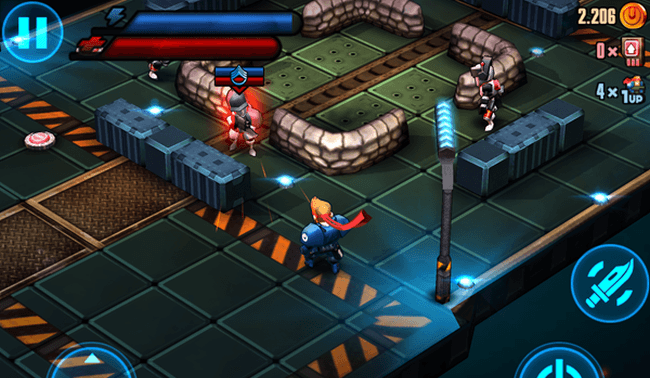
Meltdown is one of the most unique experiences I've had playing a mobile game. Like a confused college student, it has a few ideas on what it wants to be, but it gets lost in its own search for an identity. On paper, that identity is easily understandable. In practice, there are two experiences that are nearly identical. The single difference between the two is enough to shake the game's foundation.Upon first glance, it'll seem like Meltdown is a lot like Bastion, which is a fair assumption. The birds-eye camera view and the 360-degree motion result in this game controlling much like Supergiant's indie hit. Your character carries two guns and a melee weapon. Each gun can be purchased and upgraded by spending coins and upgrade cards dropped by enemies.Customization is one of Meltdown's strong points. Projectile weapons and your character all have individual skill trees. When a gun has been upgraded nine times—it's maximum—a new one will appear in the shop. Your character's skill tree is similar, but lacks the hard limit. You can choose to obtain skill boosts in damage, health, and weaponry. You can ultimately fill it out completely, so there's not much risk in selecting the wrong path. Regardless of skills and which two weapons you equip, you'll play the game the same way, only ammo types and meter regeneration changes.Meltdown's level-based gameplay is the bulk of what the game offers. The default controls are annoying, at best. I found myself trying to adapt to the touch-heavy controls, only to become frustrated and quickly go digging in the options menu. Fortunately, there's an excellent control scheme that mimics a game pad. This setup lets you move with a virtual thumb stick and press virtual buttons for shooting, dashing, and using a melee strike. There's also controller support for those with a compatible pad.
The AI is relentless. It is reprogramming itself to wrest control of the station, and it appears on my comms to enlighten me as to what my fate will be. It appears as a "he" and, though polite, he carefully informs me that I am a little more than a virus to him - a bug that must be eradicated. What follows is nothing short of soul-crushing monotony and a host of poorly conceived control and mechanics issues that leave Neon Shadow feeling bogged down and nearly unplayable.The evil AI has been a staple of sci-fi within the world of entertainment since 2001: A Space Odyssey's Hal was asked to open the pod bay doors. And yet, despite this well-worn material, the concept itself is rife with opportunity. Think to such classic gaming experiences as the Mother Brain of Chrono Trigger and you've got a recipe for multi-genre overlap. Unfortunately, any subject matter is only as good as its execution, and Neon Shadow is executed poorly."Controls are of the virtual variety, an element that has certainly become common enough to be implemented well. The option to lock the virtual joystick to a static location is helpful enough, but the camera and shooting buttons rest right on top of one another: meaning you'll either shoot when you wish to move, or vice-versa. Additionally, it is uncomfortable to switch between camera control and firing, and this often results in little choice beyond coming to a complete stop to survey your surroundings.A learning curve is implied within the framework of today's modern gaming experiences (especially mobile), but when enemies swarm from multiple directions and make movement impossible, all you can do is stand in one place, hope for the best, and curse your depleting health bar as you frantically try to locate that incoming fire, that ill-intentioned quad-copter, or what appears to be some sort of laser-mounted robotic vacuum cleaner.
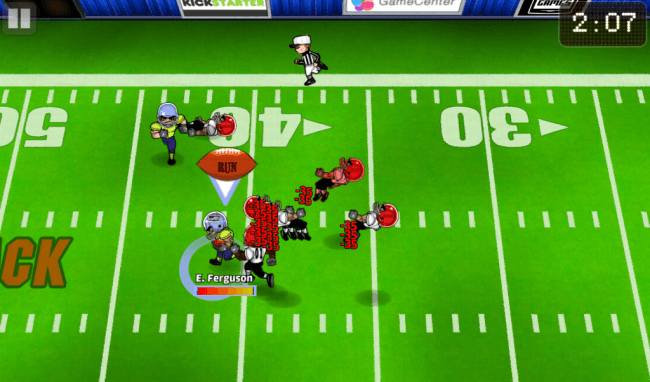
Evidence is rapidly mounting that the physical abuse real football players take on the gridiron is bad for their long term health. Happily, football players in video games suffer no ill effects, so we can pile on the excessive violence guilt-free - especially when it comes via Football Heroes and its nostalgic, over-the-top arcade action. It's a big play concept that sadly comes up short of a touchdown due to frustrating controls and annoying glitches.Run Games pitched the Kickstarter community on the idea of a football game with beat 'em up and RPG elements inspired by classics like NFL Blitz and NBA Jam. Not surprisingly, backers rallied around that concept, and the result is a game that challenges you with building the best possible team for winning at a, shall we say, very physical style of football."Since one of the main offensive and defensive techniques is punching opposing players, that's possibly an understatement. You start Football Heroes with a full squad of 18 (the games are 8-on-8, plus you get a kicker/punter and a kick return specialist) athletes ready to take part in a series of tournaments and leagues. They're just not very good at first, so you've got to train them up by playing, and hopefully winning, some games.The controls are simple enough for anyone to understand. A virtual thumb stick makes players run, and can appear nearly anywhere you touch on the screen. Tapping the screen throws punches, while tapping on players either switches who you control (on defense) or throws a pass to that player (on offense). Swiping in any direction launches your guy into a head-first diving tackle.
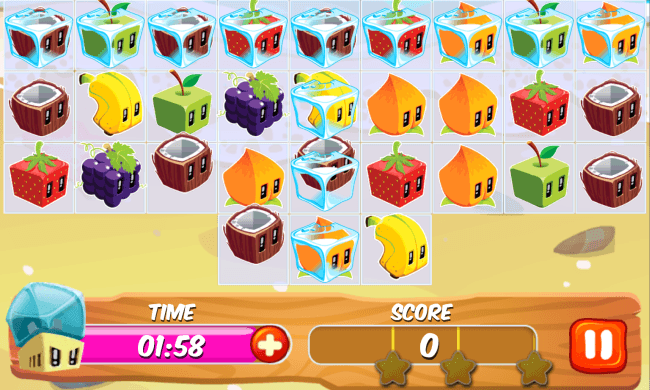
The new trend in match-three games is to draw lines through matching icons rather than shifting their positions. This interesting evolution not only gives players a new way to enjoy matching three, but it challenges them to solve similar issues by distinctly different means. Pocket Playlab's free-to-play Juice Cubes embraces the trend in hopes of attracting some of the Candy Crush Saga crowd; unfortunately, it fails to convince us that fruit is better for you than candy.Juice Cubes (which I keep wanting to call "Juicy Fruit") is born of a collaboration between Rovio Stars, the publishing arm of Rovio Entertainment (known for the Angry Birds franchise) and Pocket Playlab, the makers of another cube-themed game, Lost Cubes. (Fans of Lost Cubes, be warned—Juice Cubes' gameplay is completely different.) It's set among a series of small islands inhabited by things like sentient hermit crabs, pirates, and giant octopi, and these nautical natives all have one thing in common—they have problems. In their fancifully fluid world, those problems are solved by clearing levels using an easy-to-learn match-three technique, and who better to do that than you?"As mentioned before, Juice Cubes employs a match-three method wherein you connect static icons by drawing lines through them. The nine-by-nine board is covered with apples, strawberries, bananas, and coconuts and these can be connected vertically, horizontally, and diagonally. As "match-three" implies, matches require three or more of the same icon; matched icons burst, allowing the remaining ones to cascade toward the bottom of the screen. Unlike other games in the genre, in Juice Cubes there's no such thing as automatic matching, so cascades do nothing but rearrange the board. This makes for slightly different gameplay, but also eliminates the possibility of achieving the explosive random combo-chains achievable in games like Bejeweled and Candy Crush.
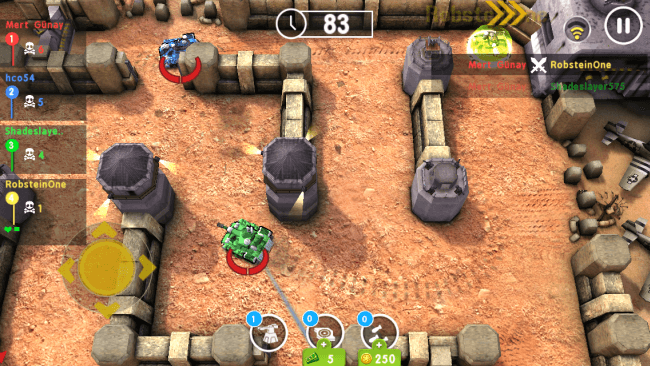
Remember Combat for the Atari? No, I suppose not. Well, it was essentially a game where two player-controlled tanks faced-off in an arena while trying to decimate each other for points. Tank Battles is sort of a modernization of the original; only now with nicer visuals, online play, and a bunch of ways for players to upgrade their performance. Unfortunately, the emphasis on premium currency makes it feel a little too modern.The single player in Tank Battles involves a series of increasingly difficult missions for players to complete. Each one has a total of three stars that can be earned by completing specific objectives (i.e. destroy everything, finish in under X seconds, etc.), and those stars will unlock even more missions or access to new gear in the shop. The general idea is to not get blown up while blowing up everything else, but sometimes the objectives will throw players a curveball and mix things up a bit. The basic controls will have players guiding the tank around a small arena using a virtual stick in the bottom-left corner of the screen, while tapping anywhere else to fire in that direction. A set of three item buttons is also preset at the bottom of the screen, and will activate whatever is equipped with a tap."Multiplayer is mechanically similar - what with the control scheme, wanton destruction, and small arenas - but in many ways feels more like a traditional deathmatch. Up to four players square-off and try to annihilate each other in order to get the highest score, while also keeping an eye out for random power-up drops like health and damage boosts. It doesn't earn stars like the solo mode, but it does allow players to compete for leaderboard status (and rewards), as well as some extra coins.
Ever since Super Mario Kart came on the scene back in 1992, there have been dozens of imitators. Some have come from established properties, such as Crash Bandicoot or Sonic & SEGA All-Stars Racing, while others have been crudely-made, cheap cash-ins which often feature licensed properties (such as M&M's Kart Racing).You'd be forgiven for thinking that Garfield Kart would be among the latter; we certainly did. Much to our pleasant surprise, however, this title is actually an extremely competent entry into the kart-racing sub-genre. Don't get us wrong, it's not likely to light the world on fire, and Nintendo has nothing to fear as they prepare for the upcoming eighth entry in the series that started it all, but Garfield Kart is a surprisingly solid and sturdy racing game."Based more specifically on The Garfield Show than the fat cat's newspaper or other incarnations, Garfield Kart features a cast of eight characters, including Garfield, Odie, Jon, Nermal, Arlene, Liz, Squeak, and the toon-original Harry. Each looks just like their cartoon self, but at the outset, you can only use Garfield or Jon, while Liz, Odie, and so on get unlocked as you continue playing.Locations seem to come from the cartoon (Full disclosure: While we've seen some episodes of the toon, we've not seen them all), and while they provide a nice degree of variety—more than seen in some racing games—it's admittedly not as diverse as what you're likely to find in Nintendo or SEGA's offerings.
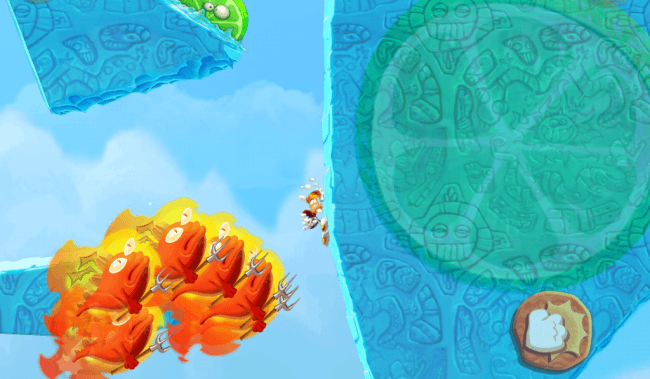
Rayman has always been one of gaming's true platforming greats, and not only has he managed to help define the genre of running and jumping in its early console days, but he's also been able to perfectly adapt to every change of the times along the way. Last year's wonderful Rayman Jungle Run was a brilliant adaptation of a platform-runner on mobile, and is easily one of my personal favorite handheld games even to this day. I think many others would also agree: which is why it's so amazing to find that its incredible sequel, Rayman Fiesta Run, is pretty much better in every single way.For one thing, the graphics in Rayman Fiesta Run are a huge step up from the last game, if you can even believe that, since Rayman Jungle Run already looked so good to begin with. The influence of the recently released Rayman Legends on home consoles is immediately apparent, and every character design and environment has a gorgeous painted feel to it. The namesake Fiesta theme is in full force here as well, with many levels alternating between spicy fire and chilly ice environments, and a smorgasbord of food-based elements for Rayman and friends to interact with. Prepare to be bouncing off of lime wedges and plump little sausages, swinging along vines made up of countless chili peppers, and running through a level that's made entirely of cheese. The fiery soundtrack is just as lively as ever, and serves as the perfect background for you to dance with your disembodied feet."The different level designs in Rayman Fiesta Run are absolutely top-notch, and the variety between them will always keep you platforming in exciting new ways. Most levels will have you running to the right and jumping over gaps as per the usual, but then other ones will throw a monkey wrench into the mix by making you run left the entire time, shrinking you down in size and pitting you against a vastly enlarged and grotesque obstacle course, and even fleeing from a boss monster that's constantly nipping at your heels. While things start out simply enough (Rayman will always run forward automatically, and a simple tap on the screen will cause him to jump), it won't be long before you begin to unlock new move sets that should be familiar to fans of Rayman Jungle Run, including Rayman's punch attack, air gliding, and the ability to run up walls.
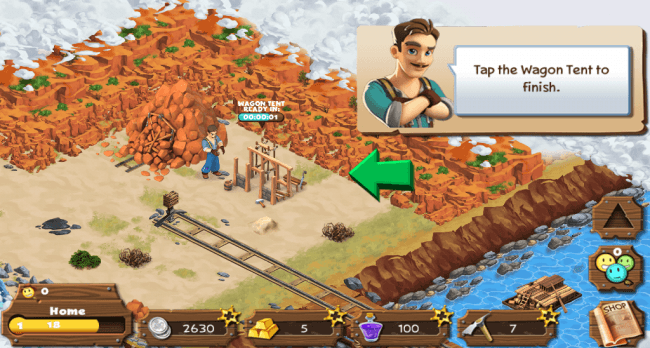
Kiwi Inc. may be a young company, but its games have already been numbered among the Top 100 Grossing applications on Google Play. This week, the company attempts to crack the Top 100 list once again with western-themed social sim, Westbound. This FarmVille-like mobile title features everything we've come to expect from town-building games; unfortunately, it does nothing to advance them.Westbound begins without preamble, and immediately upon starting, you're whisked away to a desert location where you find a guy trapped under a wagon wheel. You let him out, and he asks for help exploring the nearby cliffs. You go along with the idea (because if you don't, the game's over), and the two of you find a pretty lady trapped under some rubble. You help her out (while wondering if everyone out West just stands around waiting for something to fall on them), and then the three of you set about constructing a settlement.This all sounds fairly dynamic, but like everything in this kind of game, it's all accomplished by the repetition of two things: clicking and waiting. Westbound teaches you this click/wait technique in a brief tutorial that demonstrates building structures, planting and harvesting fields, removing random debris, and exploring the surrounding cliffs. It then introduces you to quests, which are simple assignments given to you by the main characters. You might, for instance, be asked to perform some kind of settlement-expanding task like "plant two apple trees" or "build a barn." While not particularly thrilling, these tasks do move the game along by giving you specific things to do. Once they dry up however, you're faced with a choice: extend your play time by spending money every few minutes, or stop playing altogether.


![All VV Ultimatum Titles [How to Get]](/wp-content/uploads/2026/06/vv-ultimatum-titles.jpg "All VV Ultimatum Titles [How to Get]")