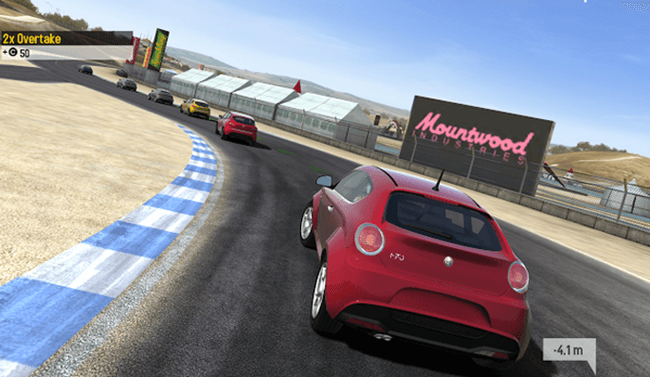
Gameloft's GT Racing 2: The Real Car Experience comes packed with a sense of familiarity. As I sat down to play my first race, I caught myself ignoring most of the tips and guides. I hardly read anything while navigating the menus because everything was laid out in the way I expected. When the game was walking me through my first car purchase, I breezed through it because it felt like I had done it all before.In fact, I had done it all before. In sports, coaches usually operate under the idea of "if it works, we'll keep doing it until it fails." With GT Racing 2, Gameloft has shown commitment to that plan, and everything works the way it's expected. Right from the start, if you've played any other recent racer, such as Real Racing 3, you'll know what to expect. In some cases, such extreme familiarity can lead to a game's demise. GT Racing 2 is polished and fun enough to overcome this obstacle."Despite the constant feeling of familiarity, GT Racing 2 doesn't assume you've played any other mobile racer. It does a fine job walking you through the start without becoming overbearing or boring for those experienced with the genre. I never found myself growing impatient with the tutorial or grumbling about not being able to skip it. I only wanted to keep racing, and I was in luck.Obviously, racing is a key component to GT Racing 2, and on that end, it excels. The numerous control schemes all work well, though the default tilt control feels like the way the game is meant to be played. There's braking and steering assistance, which can be disabled at the start of every race. The heads-up display is standard fare, complete with a speedometer, lap and position counters, and a mini-map. The one unique feature is the guide line. As you drive, you'll notice a green line on the road. This is Gameloft's idea path for players to take, thus optimizing their performance.
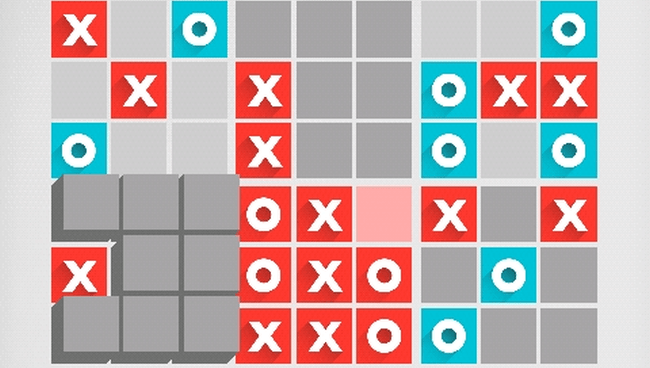
The title gives Tic Tactics away. It's the age-old game of Tic-Tac-Toe with a tactical twist, spread out across nine separate Tic-Tac-Toe boards that collectively form one mega, meta-board. You control where your opponent moves, and your opponent controls where you move, and in spite of that rather oddball description it's actually very simple to play, and also insidiously entertaining. Understand?Probably not. Okay, imagine a Tic-Tac-Toe board - perhaps better known to some of you as X's and O's. Now imagine that each of the nine squares on the board is comprised of another, smaller Tic-Tac-Toe board. To claim one of the squares on the big board, you must win the game of Tic-Tac-Toe in that square. Win a game, claim a square, and when you've claimed three squares in a row, horizontally, vertically or diagonally, you win. Easy peasy - that's Tic Tactics."But there's a catch! Oh, isn't there always? You alternate turns with your opponent, chosen at random, from amongst your Facebook friends or in a "pass-and-play" game with a real person, and where your opponent plays determines which of the nine boards you'll make your succeeding move on. Say, for instance, he plays the upper-left square of the board in the middle - you must play on the board in the upper-left corner. On that board, you play the middle square in the bottom row, and so your opponent must now make his move on the board in the middle square of the bottom row. So it goes, back and forth, until victory (or a draw) is declared.It's simple (really, it's one of those things that's easier to do than to explain), but it encourages devious play. It's not easy keeping track of the possible consequences of every move you make, and it's sometimes preferable to pass up on an advantageous square in order to force your opponent into an even more disadvantaged position. Even if a square is won, you can still be forced to play on it, but if your opponent tries to make you play on a board that's full, you'll be allowed to make your move anywhere you like.
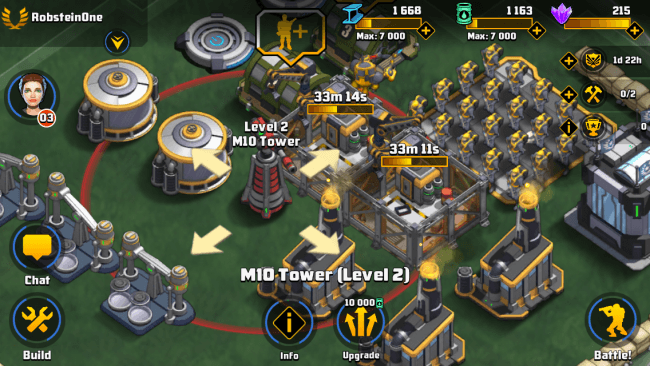
Spacetime Studios is perhaps best known for 3D MMOs on Mobile platforms, but there's no reason why they can't branch out in to new territory every once in a while. Well, new territory for them anyway. Battle Command! is, for all intents and purposes, Clash of Clans with a slightly futuristic military combat theme. It's not particularly a bad thing, and I actually prefer the look, but it's nothing ground-breaking either.Their second game of this nature after Battle Dragons, Battle Command! tasks players with turning a bland and run-down base into a formidable military installation. Also, world domination.You'll construct buildings to collect resources and train soldiers, create vehicles and aircraft, build and upgrade base defenses, and try to ransack other outposts as they fight for supremacy. Each soldier and vehicle has their own set of statistics and behaviors to account for (i.e. some target defenses above all else and others do slash damage), and knowing when and where to place them will be instrumental in successfully raiding a base.Of course the flip-side to the skirmishes is that, win or lose, players don't get to keep any of the surviving soldiers or vehicles. In other words… Clash of Clans.
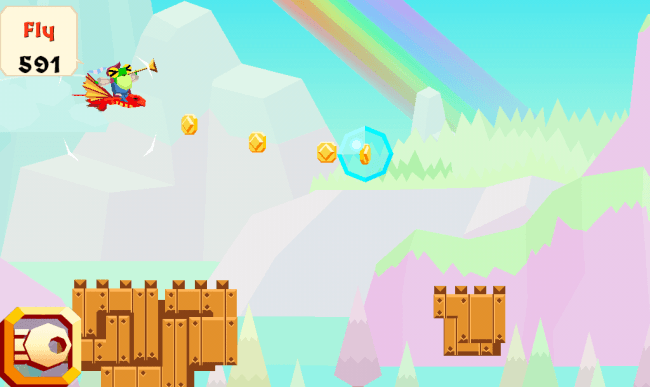
Wouldn't it be great to soar through the sky as a powerful dragon, feeling the wind whipping at your scales, and spitting out fireballs whenever something tries to get in the way of your peaceful voyage? Well now you'll actually get to see what that's like in Dragon Season, a quirky and colorful take on the endless running genre, where the skies are your friend, and the seasons are always in full bloom. But while the idea for the game is certainly cute, it won't be long before your dragon starts to lose a little bit of the steam that's powering up all of those fireballs. Boy, are my wings tired!At its core, Dragon Season is a 2D sidescrolling endless flier, as players guide a cutesy red dragon through a medieval landscape, collecting coins and breathing fire along the way. The flying mechanics might take a little getting used to at first, as your dragon moves upward in a curvy arc when ascending, and this can feel a little choppy for players who are just starting out on their dragon careers. You'll eventually fall into a groove though of tapping and holding on the screen when you want to gain altitude, and then quickly releasing your hold to drop back down and remain somewhere in the middle of the area."You can even run along the ground at times, so long as you find a clear stretch of land to do it on, and this proves to be another unique twist to the "don't touch the ground" formula in traditional endless flier experiences. Another button on the lower left-hand side of the screen allows you to shoot a fireball from your mouth, which comes in handy for blasting away the large chunks of castle walls that serve as obstacles throughout your adventure. All of these things are brought to life through a colorful art scheme, which incorporates just the right amount of blockiness and cartoony character designs to give Dragon Season a rich and lighthearted personality.
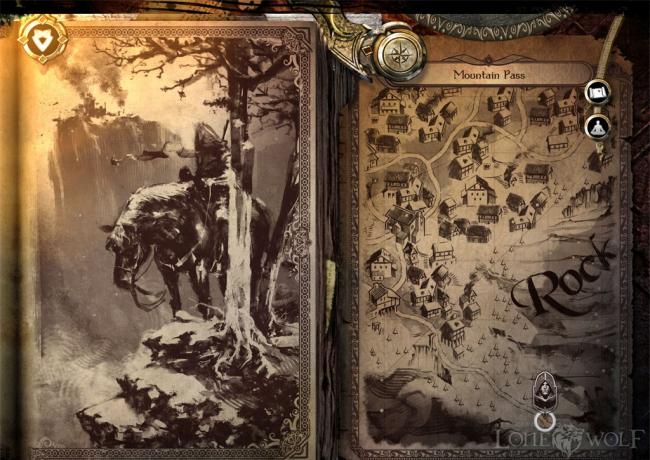
Joe Dever's Lone Wolf comes so terribly close to getting it right. And not just right, but perfect. When I first started playing I thought I'd discovered a new pinnacle in beautiful, exciting and interactive gamebooks. And then it all fell apart, and by the time it was over I was glad to see it done.If you like gamebooks (and probably even if you don't), the opening of Joe Dever's Lone Wolf will blow you away. It hits you right from the get-go with a gorgeous, subtly animated pen-and-ink style of illustration and a rich, urgent orchestral soundtrack. And choice! Lone Wolf is a well-established character with 28 gamebooks to his credit (the analog, dead-tree kind of gamebook, of course) but before the action begins you can customize your version of him to a surprising degree. Are you the stealthy type, or do you prefer a stand-up fight? Do you pay close attention to you surroundings with every step you take, or do you prefer to rely on intuition to see you through? You can build Lone Wolf into just about any kind of character you want, from a brain-smashing tank to a quiet, thoughtful diplomat.The game shows off a remarkable degree of interactivity once the action starts. Multiple choices need to be made (as with any gamebook), but skill in the form of manual dexterity is also vital. Picking locks, for instance, isn't simply a matter of looking at a stat and rolling some virtual dice; you'll have to use a lockpicking tool and a small dagger to work the lock open, and if you break all your tools, it's tough luck for you.
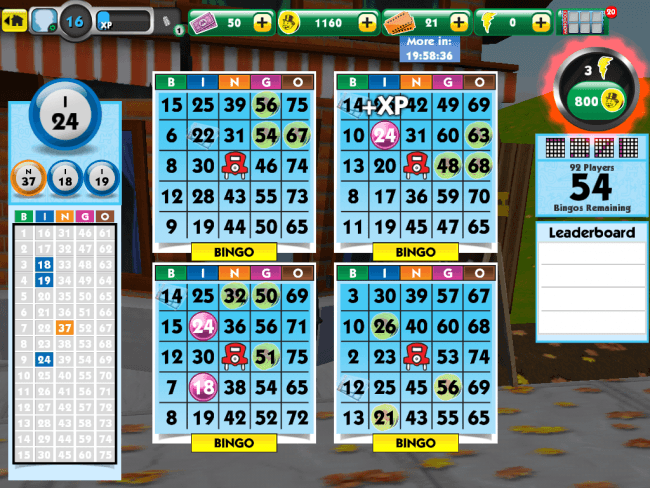
My day job is in a casino, so I've seen on slot machines how the Monopoly brand gets people excited. EA is hoping to tap into that feeling in a different way as it unleashes Monopoly Bingo,a freemiumgame for mobile devices. The mash-up between iconic board game and number-marking pastime is exactly what it sounds like, yet somehow still falls short of what it could be.Let's assume for the sake of argument that you already know how to play bingo. Monopoly Bingo certainly figures that's the case, throwing you right into the action in the first of many different rooms, each of which is themed after one of the Monopoly properties. The visual trademarks are all present and accounted for, from Mr. Monopoly to the sad inmate who is in jail and not "just visiting."The overall goal is to level up and unlock more rooms/properties. In each round, you're competing live against other players attempting to do the same thing, and there are only so many total bingos that can be scored before the round ends. Every number you mark earns you experience points, and bingos pay off with coins and extra rewards, particularly if you hit them early.
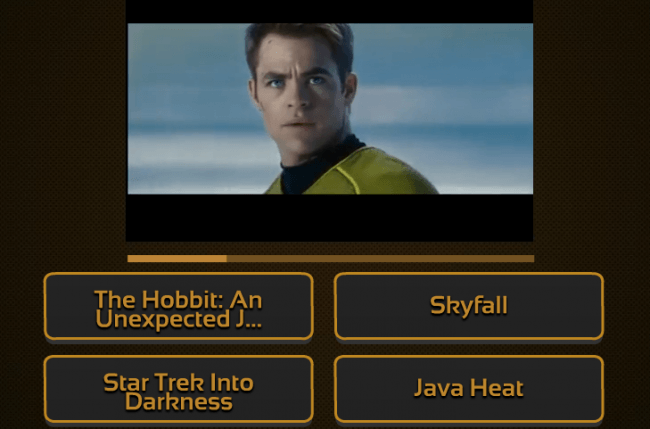
Half the fun of seeing a movie is recalling the film's best moments for years to come. What's better than sitting with a fellow enthusiast over some beers and jabbing one another in the shoulder while hooting, "Ooh! Ooh! Do you remember that one part when--"MoviePop for mobile platforms is essentially a digitized version of the excited reminiscing you do with your friends over all things movie-related. Except you play against strangers or Facebook friends, and there are visual aids galore, which renders it difficult to give a wrong answer and make yourself look like a jackass in front of your buddies. As a whole experience, MoviePop is a decent way to waste a couple of hours. Before long, however, questions start repeating, making MoviePop an easy game to ace even if you're not big into cinema.You begin a round of MoviePop by selecting a genre. There are plenty to choose from, including Action-Adventure, Family, Animation, Sci-Fi, Horror, and lots more. Granted, some categories need to be unlocked, and you're forced to choose one category from a list of three, unless you spend premium currency (popcorn!) to re-shuffle the list. But there's initially enough accessible content to keep you busy for a few rounds.
3D endless runner-type games are a dime a dozen on the App Store, so it takes something extra and/or special—perhaps even "extra special," if you will—to stand out from the rest. With the Phineas and Ferb license to use the exploits of Agent P (aka Perry the Platypus) versus Dr. Heinz Doofenshmirtz and all of the hijinks that entails, that might have been enough to do the job, at least for fans of the show (such as ourselves).Unfortunately, Agent P DoofenDASH just comes up short overall by missing a few key fundamentals, and of course, exploiting the free-to-play model. The graphics are great, despite being 3D (translating characters from the 2D hand-drawn Phineas and Ferb cartoons into full 3D models always tends to be a hit-or-miss proposition, but this does it well), and the voices and tunes almost make it feel like you're involved in another episode of the show. They even switch things up a bit by occasionally allowing you to switch over to a hang glider segment which operates much the same way as the running portions.In our experience, the controls are simply a bit lacking. Swiping left and right moves Perry in the corresponding direction, while swiping up has him jump, and swiping down makes him roll. At least, that's how it works in theory—too often, we found that we would swipe in a given direction, only to have Perry do something else, with the worst instance being swiping down to have him roll and instead seeing him jump right into the obstacle we were trying to avoid. As is often the case with these games, it only takes one small slip-up before you have to start all over, so there is no forgiveness here.Incidentally, the tutorial is a little lacking as well. Granted, there's not a whole lot to take in here, and fortunately, as noted, the glider portions operate much in the same way as the running. What the tutorial doesn't cover, however, is cornering and whether or not turning is automatic. Turns out that it isn't—back to the start, and rather quickly after just beginning the game, too. Not a great first impression.


![All VV Ultimatum Titles [How to Get]](/wp-content/uploads/2026/06/vv-ultimatum-titles.jpg "All VV Ultimatum Titles [How to Get]")