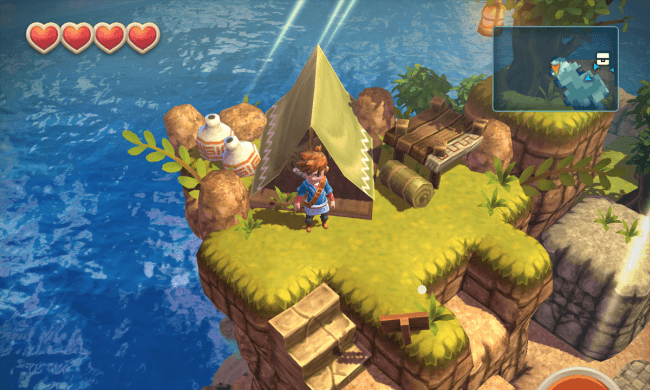
Let's get this out of the way: Oceanhorn: Monster of Uncharted Seas is the Zelda-like to end all Zelda-likes. Its similarities to and inspirations from The Legend of Zelda—especially Wind Waker and Phantom Hourglass—are numerous, pervasive, and obvious. From its silent, sword-wielding, pot-smashing protagonist to its Zora-like Gillmen to its secondary B-equipment—bombs, bow, and boots—Oceanhorn wears its muse on its sleeve. Despite its substantial list of intentional similarities, though, Oceanhorn manages to come across as a self-assured action-adventure as well as a respectful homage to one of Nintendo's finest.The story begins shortly after our unnamed hero's father sets out to find and destroy the great monster, Oceanhorn. The hero—a young boy who's already lost his mother—goes to stay with a hermitic friend of his father's on a small island. This friend soon recognizes that the boy shares the same fate as his father, and must also seek out Oceanhorn before it tears their world apart. What follows is a lengthy adventure across the sprawling, aquatic map of Oceanhorn as the hero seeks out items of power that will help him defeat the beast. While Oceanhorn's story is not its strongest point, it provides reason enough to make this journey and fills in more interesting gaps via logbook entries your father left around the world."The real star is that world, and the islands, dungeons, and challenges that populate it. Uncharted Seas is exactly that: a world built on ocean, pockmarked by separate islands that are only accessible by boat. Even without the added traveling between islands—which is much faster than in Wind Waker—the world still feels vast and open, with each island featuring its own characteristics and secrets. The Withered Lands is a desolate, sparse desert with striking rock formations; Graveyard Island is foggy and silent, with notably flat terrain; and Gillfolk's Drop—the fishlike Gillmen's home island—is a sandy paradise surrounding their shimmering hideaway. Despite these distinctions, every island shares certain structural elements that tie it to the others to create a cohesive universe: items and enemies, puzzles and logic, and a verticality that gives each area a 3D depth.
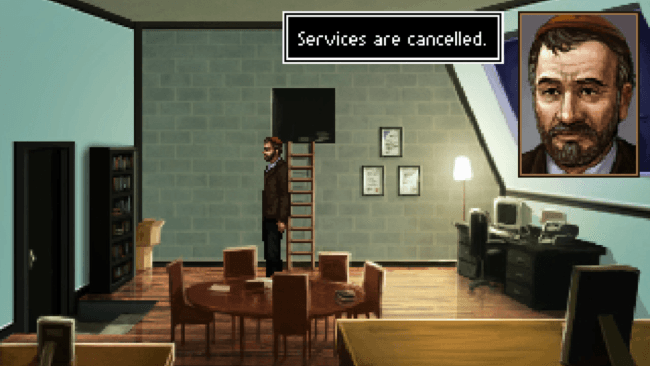
If my spirituality could be depicted as an animal, it'd be a mutt-dog with two crooked legs. My mother is an Orthodox Jewish convert from Irish Roman Catholicism. I was raised as (and identify as) a Jew, but I still had enough exposure to Christianity to notice some key differences between the faiths. Notably, Judaism doesn't adhere to a single interpretation of the Bible, and Rabbis are the kings of question-asking as a consequence. It's this small, but important distinction that drives the story - and indeed, even the gameplay - of The Shivah: Kosher Edition.The Shivah: Kosher Edition is a mobile port/remake of The Shivah, a 2006 point-and-click adventure title for PC. The game stars Russell Stone, a troubled rabbi who heads a failing congregation based in New York City. Suddenly, a windfall: the rebbe receives word he's been willed enough money to pay off his debts and keep his synagogue open. However, his benefactor is Jack, a former congregation member who departed angrily after Stone refused to bless the marriage between Jack and his non-Jewish wife."As Stone tries to get to the bottom of why he was bequeathed the money, he quickly learns that Jack was mixed up in some pretty bad business. He begins piecing things together, and comes across more than a couple of moral dilemmas on his spiritual journey.The Shivah: Kosher Edition purposefully looks and plays a good deal like Sierra's stable of classic adventure titles, especially the Monkey Island series. Rabbi Stone needs to explore his surroundings thoroughly in order to find clues, which includes interacting with people (and making sure you say just the right thing), taking note of obituaries and photos, and even hacking into fellow Jews' computers. Eh, it's just a schmear of privacy invasion.
The Lord of the Rings brand has become an almost sacred property. So beloved are the books and movies that expectations have grown to proportions nearly as epic as the journey the nine must make to Mordor to destroy the one ring. So how can familiar and exceptional stories be reworked into the video game medium while maintaining the elements that breed popularity while expanding the universe and reaching innovation? Throw LEGOs into the mix. Boom. This is LEGO Lord of the Rings, and you need it.Tolkien's massive tale of power, corruption, love, adventure, and orcs transitions into the LEGO universe with ease. That said, the iOS version is definitely smaller than previous releases. LEGO Lord of the Rings will be especially familiar to those who played last year's handheld or PC/Mac versions of the title, but whether through platform limitations or conscious choice for mobile style of play, everything has been diluted."Encounters and boss battles play out a bit differently, which in and of itself isn't a bad thing. It is, however, something to be aware of for those who are curious. In other words, there are more expanded iterations of this game floating around and just about all unnecessary mechanics have been cut, so should LOTR fans wish to experience a deeper adventure they might be better off playing the more expensive bigger brother versions.Mobile or not, there is no denying that Warner Bros. have executed a fantastic game. The LEGO gaming brand has long been known to infuse subtly humorous moments into not-so-humorous properties, and these spoofs fit with LOTR surprisingly well. For example, the opening moments—Cate Blanchett/Galadriel's speech from The Fellowship of the Ring film transposed over LEGO versions of the same events—provides a moment where one of the kings of men drops his newly-gifted ring.
A plane crash, a deserted island, and a crew of "mouth-breathing tourists" as your only companions: although it's a pitch we've heard before, developer Owlchemy Labs' take on the Lost-famous formula promises to be new, improved, and worth sticking with from beginning to its numerous, varied ends. As a survival game, Dyscourse is full of tangible dangers that can bring about those ends abruptly—such as poisonous snakes and wild boars—but one of its greatest challenges is the human psyche. Dropped into the shoes of Rita, an art graduate-turned barista-turned makeshift island leader, players will get to know their fellow castaways and make critical, interpersonal decisions that will affect the group's chances for survival. One such choice is shown off in Dyscourse's Kickstarter video: Rita sends the mustachioed tourist with a fear of snakes to subdue a venomous enemy, with less-than-desirable results. She could also opt to dispatch the snake herself, which keeps everyone alive and well. Alex Schwartz, Founder, CEO, and Janitor of Owlchemy Labs, told Gamezebo: "With a Kickstarter video, it's tough to build characters and show consequence over time, so George getting smacked down by the snake could have looked arbitrary in the setting of a two minute video. With an actual playthrough, though, you come to love (or hate) the cast of wacky characters on the island, and uncover important bits of info and background on the characters, their skills, and their motives through dialog and various moments.""Those moments determine the direction of each playthrough, which vary greatly thanks to Dyscourse's emergent gameplay. Even seemingly minor choices can create diverging paths that change one player's experience when compared to another's. "Those choices you make at any time are also not 'pre-set' in that you will always see those same options," Schwartz said. "For example, if you learned a specific bit of information about a character, or saw them do something sneaky, the option to bring that up, or use that information against them will be 'unlocked,' whereas players who didn't come across that info due to going down a different branch would not be able to see that option, but instead have a whole different parallel experience happening."
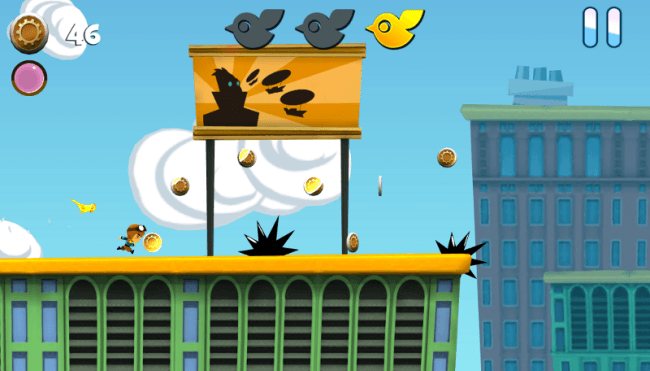
As we have all learned from cartoons, one can easily float into the air by blowing a really big bubble with some extra sticky bubblegum. The hero of AdvenChewers uses this to his advantage to float and fly across stage after stage of endless running action. Collect coins, rescue birds, and save your father before he's forced to serve the evil General!AdvenChewers features a shoestring storyline that involves a lot of steampunk machinations, an evil General bent on world domination or some such thing, and armadas of airships floating through the skies. It mostly serves as a convenient backdrop to put you in the shoes of an adventurer out to save the world. Bubblegum is the real star of the show, and it functions as the main gimmick keeping AdvenChewers entertaining."Tap the screen to jump, holding down for slightly longer leaps. While airborne, tap again to blow a bubble, holding the screen to float even higher. You can bobble up and down by keeping a good tapping rhythm going, but your bubble will eventually burst if you inflate it too far. Even bubblegum has its limits, you know.Each level in AdvenChewers features three missions you can complete to earn extra coins. For example, collect five mega coins, use special gum powers, or pick up hidden phoenix feathers that give you a temporary ride on the back of an invincible bird. Level design really encourages you to play, replay, and explore. Stages have multiple paths to check out, so it's not just jumping over holes and rescuing fowls. Look for coins hidden just off-screen, and don't be afraid to fly into the air to look for secrets. Phoenix feathers, mega coins, and other surprises often await the eager adventurer. Ahem, AdvenChewer.
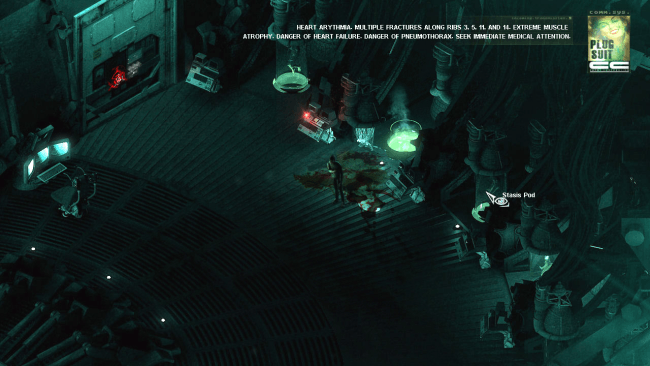
I recently played through the Stasis alpha demo, and I can tell you two things about it. First, a great deal of work remains to be done: path finding is extremely wonky, character models look like mannequins and appear to glide weightlessly when they walk, interactivity and feedback is very limited, and it's just "rough," in various ways, to varying degrees. Second, and more important, it is absolutely overflowing with potential. Even in its brief and incomplete state, it left me very much wanting more.Stasis is a point-and-click sci-fi horror adventure set aboard the research vessel Groomlake, which has suffered some sort of catastrophe that's left it nearly derelict, with most of its crew dead or missing. Systems are shut down and signs of struggle are everywhere; it also slowly becomes clear that the ship's crew was inflicting horrors of its own, long before disaster struck, as part of its mission. Figuring out why, and what role you played in it, will be an important part of understanding what went wrong.""Stasis really is an amalgamation of everything I love about science fiction," creator Chris Bischoff told me. "Alien, Event Horizon, Sunshine, Dead Space, The Dig, System Shock... they all have some element of DNA in the game. From a gameplay point of view, System Shock's way of telling its story through audio logs, video logs, and ghosted re-enactments is a heavy influence on Stasis."Bischoff is the lone developer on the game, handling everything from programming to graphics and animations, although his brother recently signed on as "the business mind" of their indie game studio, handling things like the Stasis website, community management, and contracts with voice actors. He's also involved in crafting the story, and they discuss, refine, and discard ideas on a daily basis.
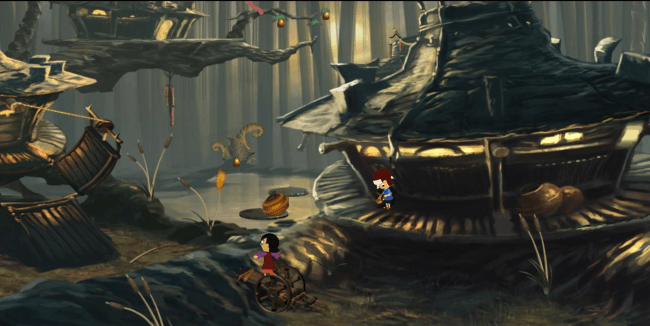
The world of Lilly Looking Through is a gorgeous, hand-painted landscape that is more Don Bluth than Disney, a place where fantasy is only the dressing of a personal, human story. Its backdrop is a mechanical, gritty reality juxtaposed with the colorful, fairy tale impression of childhood. In the shoes of young Lilly, players will explore both sides of this setting, using a magical pair of goggles that allow Lilly to see and interact with the alternate version of her current environment.Lilly's journey through this world begins as a search for her younger brother, Row, who has been wrapped up and swept away by a piece of red cloth caught in an invisible breeze. The chase takes the form of a minimalistic point-and-click adventure, with no dialogue—save a few shouts from the siblings—or inventory system to manage. Each scene is a self-contained challenge as in Machinariumor The Tiny Bang Story, with Lilly moving ever-onward once she has traversed the current screen."This means that puzzles in Lilly Looking Through are generally more decipherable than those found in sprawling, multi-location adventures like those by Daedalic. Until the very end of the game, the goal is always to get from one side of the screen to the other, with all the objects and tools required to do so located within the same scene. When a loose on-screen item is needed, it will be picked up by the player and moved to its destination directly without Lilly ever intervening. These interactions save players the frustration of watching Lilly wander around, picking up and attempting to use items futilely, and provide their own satisfying moments of physical interaction, like burning rope or popping bubbles.
In the world of Papa Sangre II, there are no such things as video games, or mobile devices, or even games called Papa Sangre, because the sad truth of the matter is that you are dead. Yup, you bit the big one. Everything you're seeing around you right now (including this review) is actually just the last waning memory of your long-lost life that you've still managed to hold onto. The good news is that there's still a way for you to be brought back into existence, and it just so happens to involve playing through one of the most captivating, brilliant, and downright horrifying mobile games ever made by the living world you've left behind. Lucky you.I'll be talking primarily about sound in this review, because as a completely auditory horror adventure, Papa Sangre II comes devoid of any real visuals. But the biggest highlight of the experience is in listening to the eerie and gravelly narration of Sean Bean, the A-list actor who's appeared in such modern classics as The Lord of the Rings and Game of Thrones. Bean serves as the perfect companion for your unsettling adventure, and he provides an immaculate balance between helping you proceed with pertinent instructions and information on how to play, and being just grim and cynical enough to keep you on your toes and never completely trusting of this dark and mysterious voice in your head. I think this probably goes without saying by now, but Bean's vocal performance is simply astounding here.To play the game is simple, although there are a few minor prerequisites that you'll need to be aware of before entering the haunting Museum of Memories for the first time. For one thing, wearing headphones is an absolute must, as a large part of the gameplay involves determining which direction something is to your relevant location, and how the sounds ultimately travel around you from your left ear to your right. Second, the game is also based around your mobile device's gyroscopic features, so you'll need to be standing the entire time you play in order to give yourself the proper mobility for turning. When you turn around in a complete 360-degree circle, you'll actually be able to hear the many environmental sounds morphing and moving places around you, just as they would in real life. And lastly, as Bean will instruct you early on in the game, you have to keep your eyes closed, and you can't open them for any reason.


![All VV Ultimatum Titles [How to Get]](/wp-content/uploads/2026/06/vv-ultimatum-titles.jpg "All VV Ultimatum Titles [How to Get]")