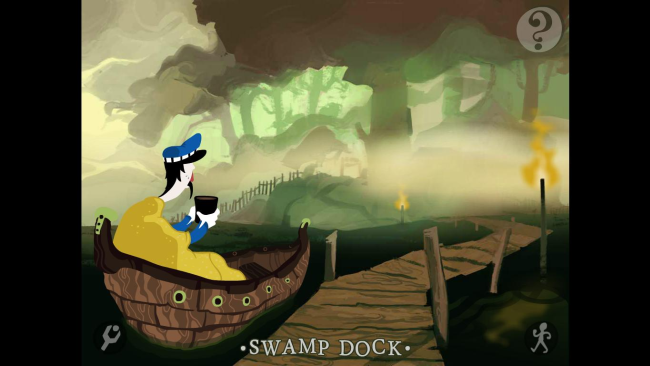
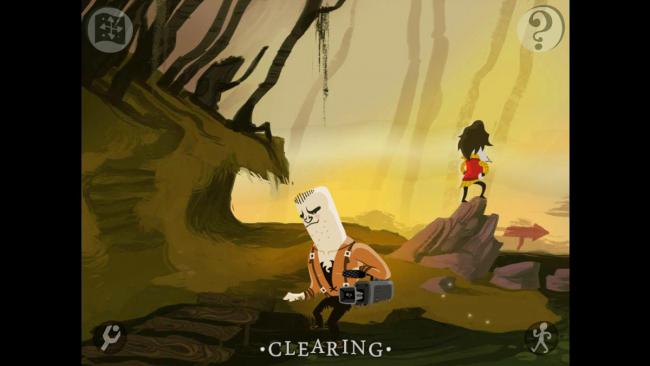
There has been a murder. Richard Remington, the owner of the swampland tourist attraction Boggy's Bog, has been killed in the murky, mushy trenches outside his office. The only suspect to start is Boggy himself, the legendary swamp creature that inspired the creation of the vacation destination and who may or may not actually exist. As the eponymous Detective Grimoire, it's your job to explore Boggy's Bog, investigate the murder, and nab the culprit—human or myth.Players familiar with SFB Games' (formerly Super Flash Bros) 2007 Flash game of the same name will recognize the gameplay in Detective Grimoire. A simplified and streamlined point-and-click adventure, much of your investigation is spent traveling around the swamp, examining beautifully animated scenes, locating clues, and interrogating potential suspects. While both Detective Grimoire and its Flash inspiration revolve around solving a murder in an amusement park, this newest entry into Grimoire's case history presents an entirely new story, cast of characters, and challenges, as well as a different, larger, and more fleshed-out world. All of the dialogue is charmingly voiced, backstories are deeper, and mysteries more elusive. At the same time, Grimoire fans will be treated to playful nods to the original, from jabs at Officer James's facial hair to an uncanny red-headed sidekick.This successful combination of lighthearted jokes and a weighty murder mystery keeps Detective Grimoire consistently engrossing. While Grimoire finds himself in a variety of scenic-yet-creepy locations, from a darkened office lined with shadowy animal heads to a teetering bridge supporting one lone house, the mood of his investigation is upbeat and often humorous. His tone with suspects is more confused than accusatory, and their reactions are unperturbed caricatures.
Detective Grimoire is apoint-and-click mystery developed by SFB Games. In this game, you take on the role of Detective Grimoire as he attempts to solve a murder in a remote tourist attraction by exploring the swamp, discovering clues, and interrogating suspects. Gamezebo's walkthrough will provide you with detailed images, tips, information, and hints on how to play your best game."
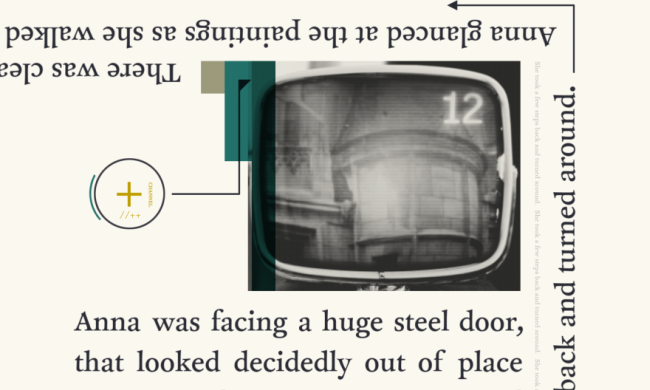
Device 6 is a puzzle game/interactive novel created by Simogo. In this game, you play as Anna, a woman who's been stranded on a mysterious island teeming with cryptic messages and curious puzzles. If she wants answers, she needs to solve everything that's put in front of her. Gamezebo's walkthrough will provide you with detailed images, tips, information, and hints on how to play your best game."
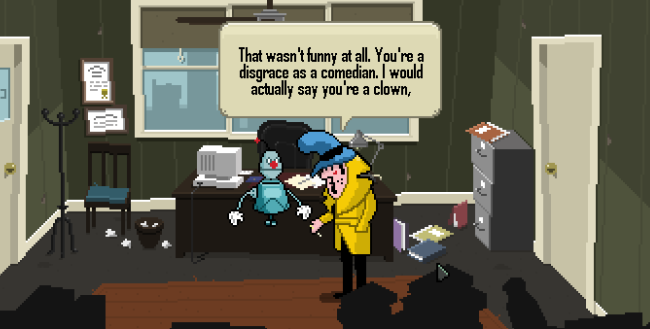
In the realm of video games, murders are typically solved by folks that are barely able to dress themselves. This time around we have a detective with an impossibly stupid-looking hat solving what's being incorrectly passed off as a suicide. Don't tell him his hat looks silly, though. You'll hurt his feelings.Murder in the Hotel Lisbon is a point-and-click adventure game from Nerd Monkeys. You play as Justin Case, an independent detective in desperate need of money (as detectives often are). One day, two unusual things show up in Justin's office: A clown robot, and an actual case to solve."The robot, known simply as "Clownbot," is supposedly an inheritance from a relative Detective Case is unfamiliar with. The timing of Clownbot's arrival is good: There's been a murder at the Hotel Lisbon that's being (poorly) passed off as a suicide. Exactly the kind of case that requires a robot's delicate, steely touch.As you might expect from a game about a detective in a goofy hat and his robot clown accomplice, the tone of Murder in the Hotel Lisbon is not the least bit serious. Detective Case cracks jokes constantly, and sarcasm flows like bitter water. Heck, one of Clownbot's functions is to tell bad jokes on command. There's even an "audience" that roars along with the zingers (and a single spectator that belts out laughter at the clunkers).
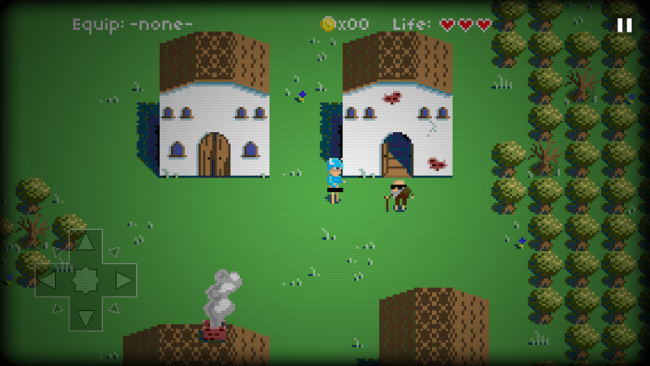
Those of us old enough to remember playing the very first Dragon Warrior game on the NES can also remember giggling over the option to buy "Clothes" as a starter armor set for our hero. "What, was the hero naked before we bought the Clothes?" we asked each other.Of course, our 8-bit hero wasn't actually naked (or at least we couldn't see his shame because of the NES's graphical limitations and/or Nintendo's strict censorship policies at the time). However, the legacy of the naked hero continues with Legend of Equip Pants, an odd, odd adventure game fueled by jokes about underwear, shorts, and pantaloons."Legend of Equip Pants tells the complex tale of Sir Pantsalot, a knight living in a kingdom that's troubled by an "underwearwolf" (amongst other monsters based on garments that secure people's junk). Sir Pantsalot is noble and true, but he seemingly has problems with indecent exposure in a very pro-pants society. He sets out to find some manner of covering for his ding-dong, but his journey is destined to be difficult.Legend of Equip Pants is, in a word, silly. It tries very hard to be funny. The curious thing is it mostly succeeds, even though it retells the same joke over and over. Strange as it is to say, the game's juvenile themes just mesh well with its retro pixel-based graphics and solemn RPG soundtrack. You'll find yourself grinning even when you try and summon your inner grade three teacher ("Boogers, farts, and underwear are not funny!")
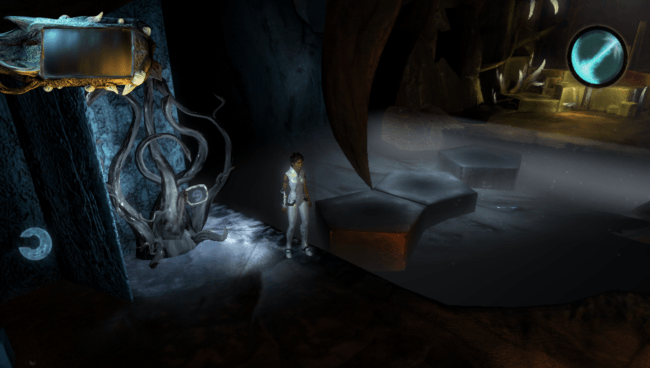
Abducted: Episode 1 is the first entry in a six-part, episodic sci-fi adventure that combines puzzle, horror, and RPG elements. This genre sampler is a mixed bag both literally and in terms of quality: while it presents a mysterious and beautiful world to explore, actually doing so is a slow process. Episode 1 lays the groundwork for a sprawling adventure across unexplored—and unsettling—reaches of space, but with less than compelling gameplay that often fails to encourage making the journey.Players take on the role of Eve, an amnesiac who wakes up on an alien ship with no memory of how she got there or anything about her past. Eve's only clue to her current status is a computer built into her arm that claims to have been with her "since the beginning" and is able to answer questions about their life together. Although the arm computer is also unaware of how or why you've ended up on this particular ship, it is able to fill in some of Eve's blanks—like the fact that she is an explorer that catalogues alien life forms—and help her investigate her surroundings. It will mostly provide information on objects from its extensive database, but the computer also allows Eve to hack into terminals throughout the ship that give her access to new areas and a potential escape."This progression through the ship takes the form of a simplified point-and-click adventure, but without any items to collect or manage. When Eve walks near an area of interest, it glows faintly and can be viewed for more information. Most items exist solely to describe the ship's atmosphere: gazing out a window might describe the asteroids in the distance and comment that you are definitely far from home, while examining a broken piece of machinery may explain its original purpose and ponder "Is it repairable?" Since Episode 1 is linear and Eve's goal is always clear, these areas of interest are rarely needed to move forward and serve only to expand the alien environment.
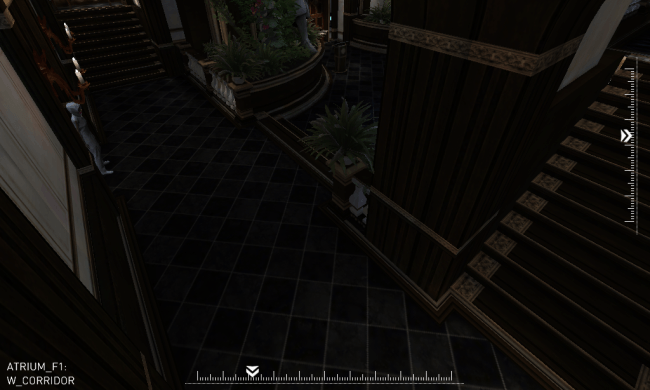
It's a surveillance society, and we're all just living in it. At my day job, I have to admit that I happily contribute to it. Other times I do wonder about the implications of it all, and the folks at Camouflaj obviously do too. Their sci-fi stealth survival game République explores the positive and negative aspects of omnipresent cameras and a connected civilization, and does it with a storytelling flair few mobile games have managed to date.If setting the mood of a video game was a college course, République Episode 1: Exordium would be the professor. You meet the game's protagonist, a girl named Hope, when she calls you for help. She may or may not have read something she shouldn't have, which is against the rules in the (apparently near future) city of Metamorphosis. The Orwellian buzzwords fly during the opening scene of dialogue - Recalibration, The Arrival, etc. - but it's clear Hope is in trouble, and only you can help."The reason you can help is both a plot device and a nifty gameplay mechanic. It turns out you are hacked into the surveillance system of this particular totalitarian nightmare through Hope's cell phone. You can hop from camera to camera to see where Hope can't, looking ahead to help her evade her captors.And that's just the tip of the iceberg. Using the special OMNI software, you can not only see how the cameras are linked together, but you can also pull off useful tricks like unlocking doors, seeing through walls to find the guards, and finding items like pepper spray. You'll also find pieces of propaganda that fill in the game's world and work as currency you can trade for additional abilities, like scanning the guards' email and causing distractions.
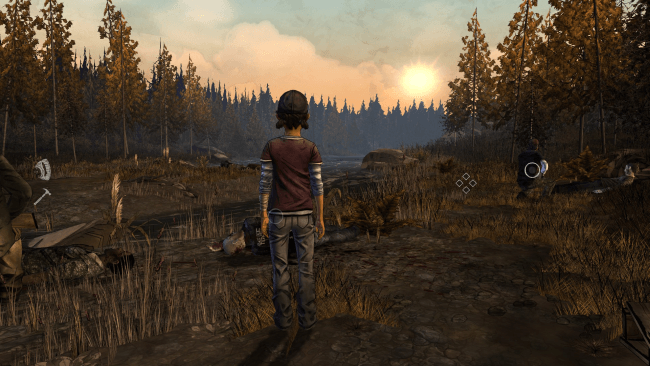
Telltale's highly anticipated The Walking Dead: Season Two is finally here with its brisk and brutal first episode, All That Remains. While the main story picks up 16 months after the end of Season One, the game wastes no time in reminding us of its inner darkness, with unnerving decisions around every bend, the occasional walker or two to keep you on your toes, and of course, the dangerous and distrustful individuals in Clementine's path who serve to remind us that Telltale isn't holding anything back. If only the episode as a whole wasn't so short and actually let us take control for more than a few minutes!As the episode's title would suggest, there is a reoccurring theme of aloneness that permeates the entirety of All That Remains. After the events of Season One and the heartbreaking first few minutes of this new installment, Clementine has all but been left to fend for herself, with a large chunk of the episode being devoid of any other human interaction. The few poignant remnants of Lee's memory that are expertly woven into the surroundings pack a serious emotional punch, and the overall direction that Telltale chose to give to their little heroine (not the least of which making her the playable character) is nothing short of genius."But despite the more low-key direction of this opening episode, there's no doubt about it that All That Remains is easily one of the most brutal experiences that Telltale has ever crafted, and probably features a few of the darkest and most unsettling moments that we've seen in a Walking Dead game so far. I was constantly shocked and stunned by some of the violent twists that occurred within the opening first hour, and one event in particular that involved an abandoned dog literally had me begging for the encounter to end: and then so of course, Telltale designed the game to prolong it even further in a way more excruciating fashion.


![All VV Ultimatum Titles [How to Get]](/wp-content/uploads/2026/06/vv-ultimatum-titles.jpg "All VV Ultimatum Titles [How to Get]")