Over the past few years, game bundles have risen to become one of the most popular ways that games are purchased digitally. "Pay what you want for X-amount of games for a super discounted price" is a particularly popular practice throughout the indie game scene, as it offers developers a great way to get their games in front of a massive amount of buyers. Humble Bundle, Indie Royale, Groupees, and Bundle Stars are all popular game bundling brands that promote both games and developers while (typically) allowing the buyer to select a price-point.A few sites are taking ethically-questionable advantage of these deals, buying keys in bulk and then selling them at a later date for a profit. While initially it sounds illegal, there is no concrete court ruling that says it is, in fact, illegal. The closest court case found in the United States was a 2008 ruling that selling "not-for-resale" promotional CDs is legal. In 2012, the European Court of Justice ruled that the first-sale doctrine does apply to digital games, and individuals can resell their lawfully purchased property without penalty.So lawfully buying bundles of keys, and then selling them at a later date, is considered akin to selling a book bought at a book store, later on at a garage sale. There is no definite ruling in the United States, like there was with the European Court of Justice, but it certainly is only a matter of time until a similar ruling makes its way to the US.The real debate boils down to the ethics of it all. Especially concerning the profits, or lack thereof, collected by indie game developers.
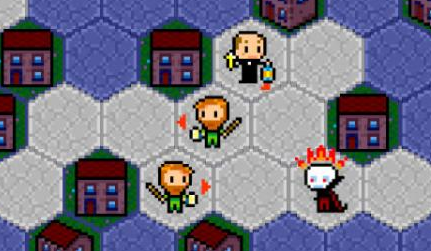
Earlier in the month, between March 8th and 16th to be exact, the Procedural Death Jam saw developers from all around the world come together with the common goal of producing games based around the Procedural Death Labrynth genre, formerly known as "roguelike-likes". The two core rules involved with the game jam were that the game must feature procedural generation and permadeth. Over seventy games were produced and entered into the jam, and a handful of games walked away with awards.Lamp and Vamp, developed by Globz, walked away from the jam with both Best Game and Best Art awards, and for good reason. Lamp and Vamp is an enjoyable strategy game where players must navigate a vampire to his coffin through a randomly generated neighborhood, while avoiding the local neighborhood watch, determined to catch them. Movement is based on a tile system, each turn the player can move to any adjacent tile, and the vampire hunters also move one tile. The catch is that the vampire hunters have torches and flashlights, and can see ahead. If the vampire is caught in the hunter's line-of-sight, all the hunters in the neighborhood will converge and attempt to corner the vampire, resulting in death.
For a child star whose celebrity came and went in the blink of an eye, Macaulay Culkin saw his likeness in a surprising number of movie-based video games. Home Alone is pretty much a give in, and 1994's The Pagemaster saw a home video game adaptation too.But what about My Girl?Somehow overlooked, this horribly tragic tale of young love (and SPOILER: death by bees) never got the video game spin-off it so sorely deserved. But now, thanks to the internet, it has.It's a short experience, and probably in poor taste, but it made us laugh/cringe an equal amount. If My Girl broke your heart when you were 11, this browser game will let you relive your shock and horror all over again.MyGirlTheGame.com. You're welcome.
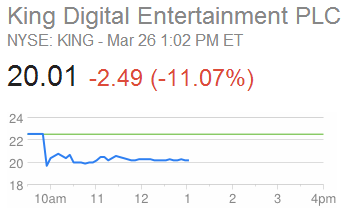
This quote from ever colorful CNBC personality Jim Cramer after King Digital stock began trading on the New York Stock Exchange earlier today should give you a hint:"It's a Stephen King horror story," Cramer said. "It might be Misery, it could be even Cujo."While there are plenty more (and better) puns that could be made from comparing the King IPO to the works of the master of horror, it's clearly not been a good first day for the company best known as the developer of Candy Crush Saga. After pricing its stock at $22.50 a share, King Digital has seen its stock price fall to as low as $19.08 in its first morning of public trading. As I write this, it's currently at $20.06 a share, down 10.8 percent on the day.
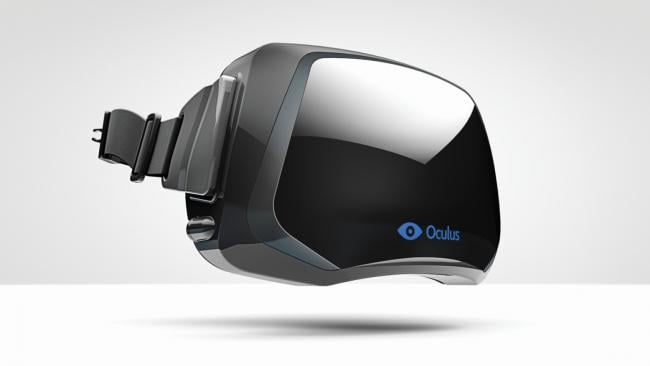
What happened? In a move that surprised just about everyone, promising startup Oculus VR was bought out by Facebook for $2 billion (well… $400 million + $1.6 billion in stock. You interpret that how you want).Who the @#$% are Oculus VR? If you're not into gaming, that's a pretty good question. If you are into gaming, shame on you. Birthed on the back of a successful 2012 Kickstarter campaign that raised $2.4 million (nearly 10x the project's goal), Oculus VR are the company behind the Oculus Rift: a head-mounted virtual reality device that's expected to seriously shake up the gaming world.Virtual Reality? Is that still a thing? A fair question. In its earlier incarnation, virtual reality was kind of a bust; a fad that came nowhere close to living up to its potential (remember Lawnmower Man? VR in the 90's should have been awesome). The folks at Oculus, however, realized that the combination of 90's VR dreams and 21st century technology could create a pretty powerful future.Come on… Who's going to believe that? John Carmack for one. The co-founder of id Software and lead programmer on DOOM left the company he helped found because he couldn't convince their parent company to take a gamble on bringing Doom 4 and Wolfenstein: The New Order to the Oculus Rift. Two months prior to leaving id, Carmack became Oculus VR's CTO. That's now his full time gig. Guess he'd better get used to calling Zuckerberg "sir."
Earlier today, Facebook CEO, Mark Zuckerberg, announced the acquisition of Oculus VR, Inc. for $400 million in cash payouts and $1.6 billion in Facebook stock shares. The acquisition comes a little over a month after Facebook purchased cross-platform mobile messaging service WhatsApp for $16 billion. The deal is expected to be finalized in Q2 2014."Mobile is the platform of today, and now we're also getting ready for the platforms of tomorrow," Zuckerberg said today in the press release. "Oculus has the chance to create the most social platform ever, and change the way we work, play and communicate."Of course, Oculus VR, Inc. is excited for the opportunity. The $2 billion acquisition follows last December's $75 million investment by venture capitalists and the successful Kickstarter campaign in 2012 which raised $2,437,000. While the $75 million investment was a move towards producing consumer versions, currently, only Oculus Rift development kits are available for purchase, the most recent of which costs $350. Consumer versions are expected to be available by the end of the year, or early 2015.
"Gamification" is a dirty word. Most don't mind seeing RPG elements worm their way into every genre of game, but mention doing it with fitness, learning, or your diet and those same people will likely roll their eyes.Europe's first-ever Newsgames Hackathon stands a chance of changing that.A "newsgame" is a gamified method of presenting journalism - be it a feature, opinion piece or a standard new story. The concept was successfully employed by the New York Times' "How Y'all, Youse, and You Guys Talk," an interactive quiz that became the site's most visited "story" of 2013. A hackathon (aka game jam) is when a group of artists, writers and designers gather in one place and build games in a very limited amount of time. It's a popular concept in independent development, and now The Good Evil and the Cologne Game Lab are teaming up to bring the concept to journalism.
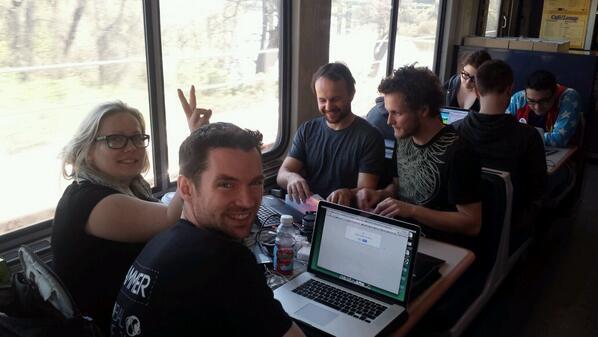
Game jams have become an increasingly popular way of helping developers connect, both to one another and back to their passions. It's interesting, then, that the first-ever Train Jam, a 52-hour game jam set entirely on a train from Chicago to San Francisco, their final destination GDC, was themed as "disconnection."Like any jam, the idea is to conceive, conceptualize and create a game in the allotted time based on the preconceived theme. Gamasutra's editor-in-chief, Kris Graft, ran a lovely trio of features on what sounds like just the first of many successful Train Jams and the games that resulted. Zoe Quinn, creator of the game Depression Quest, worked on a project about maintaining social connections while running the indie game convention circuit. Rami Ismail, one half of Vlambeer, the company behind Ridiculous Fishing, Super Crate Box and Luftrausers, was there as well. He made an Android game requiring him to physically fend off players from tapping an onscreen "D" (for Disconnect, the name of the game as well as the theme) on a tablet strapped to his back.


![All VV Ultimatum Titles [How to Get]](/wp-content/uploads/2026/06/vv-ultimatum-titles.jpg "All VV Ultimatum Titles [How to Get]")