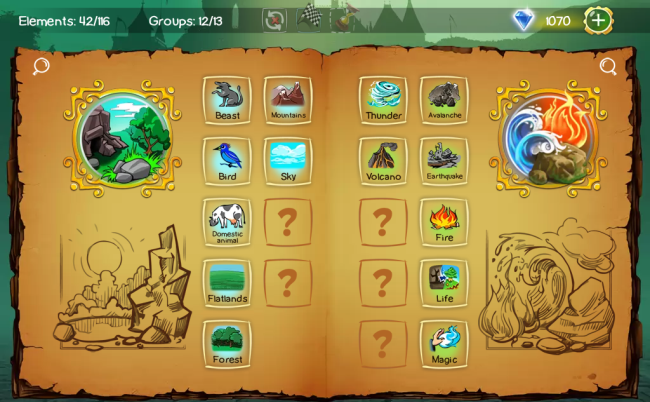
After several games and several million downloads under their belt, JoyBits has returned with their first new game in the Doodle series in over two years. The original Doodle God staked its claim in the gaming world by having players combine two different elements in order to create a third, and then using that third to create a fourth, and so on until a rich and resource-filled world materialized right before their very eyes. While Doodle Kingdom builds upon this tried and true formula with a fresh thematic twist, the game also tries a few new things to usher in this latest era in the Doodle universe as well.This time around, there are an initial 116 elements to discover across 13 different categories, and if you're a fan of any Doodle game before it, then the odds are you'll feel right at home in this one. Things start out simple enough, with your typical "Human + Forest = Berries and Lumber" equations, until the main draw of Doodle Kingdom begins to kick in: the medieval fantasy elements! Given its name, the game has an inherently medieval theme, and a lot of the elements you'll discover fit into this mold perfectly: from Golems and Dwarves, to Catapults and Forges, to even Unicorns and a Pegasus. It's certainly a breath of fresh air for the game and the series, and one that really ramps up the challenge by forcing you to push your imagination to its limit (related: if anyone knows what the heck a Unicorn can be combined with, you know where to reach me)."Luckily, Doodle Kingdom implements a fairly attractive hint system so you're never stuck for too long, with lots of good incentives to spend currency on more of these nudges in the right direction, but never any hard requirements to do so. There are three different forms of hints you can choose from in the main game: ones that reveal an element that can be created from your existing ones; another that shows two categories which currently have an undiscovered reaction between them; and a third which automatically makes a random elemental pairing for you. Each one has its own addicting benefits, and daily rewards for playing will keep your pockets full of currency to purchase more by the bundle.
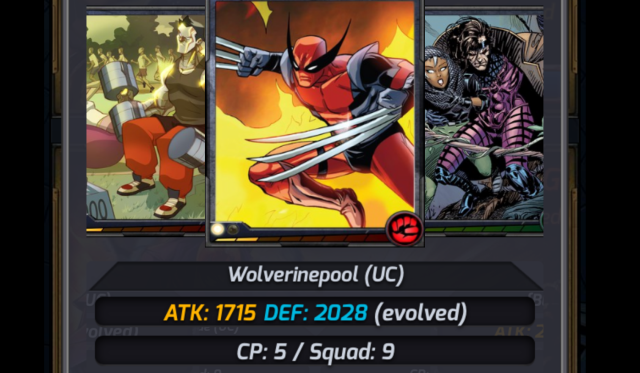
X-Men: Battle of the Atom is a new free-to-play card battle game that lets you face off against the forces of evil at the head of a famous band of mutant superheroes including Scotius Summerisle, Stepford Cuckoos, the Glob, Cipher, and Cypher. Wait, who?If you're a casual X-Men fan - you enjoyed the movies, maybe read a few trade paperbacks - then the first thing to know about Battle of the Atom is that it's probably not the X-Men you X-pect. As a tie-in with the "Battle of the Atom" comic crossover that began in the fall of 2013, the mobile game features "hundreds of characters spanning 50 years of X-Men history," according to the App Store description. To fill a roster that broad, Aeria Mobile brought in just about everyone who ever appeared in a mutant comic book, from past, present, future, and even alternate worlds."The net result is a menagerie that might be familiar to die-hard fans of the franchise but is largely baffling for anyone who thinks of Thunderbird or Northstar as "exotic" X-Men. This would be fine if it was actually a good CCG, but that's the real problem with Battle of the Atom: It isn't. It is, in a word, boring, and while that may be at least in part due to the cookie-cutter nature of the CCG genre, there's simply nothing about this one that makes it stand out from the crowd.All the usual CCG elements are here: Battle enemies by tapping the screen, collect points to recruit new cards, enhance and evolve cards to make them stronger, build a powerful deck, square off against your fellow players and, when your stamina runs out (which will happen relatively quickly at higher levels), stop playing until it recharges or fork over some money to make it happen immediately. But it's unengaging and flat, and comes off feeling like a minimal-effort tie-in mandated by the marketing department and farmed out to the lowest bidder.
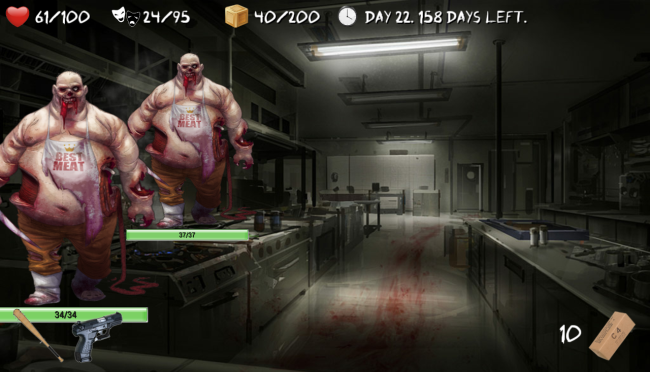
Overlive is a promising mix of things. On one hand the game is a tap-and-shoot zombie shooter, and on the other hand it's a choice-driven narrative full of decision making. Unfortunately, neither one of these elements stands out memorably. The combat scenarios involve simply tapping at static images to shoot, or swiping a finger across the screen for a melee attack, and while the writing was grammatically sound, by the end of my playthrough I was left with more dead-end subplots than I cared to remember.In the game, players are tasked with escaping a zombie-filled city before the local nuclear power plant has a meltdown and blankets the area with atomic radiation. Instead of simply tossing players a shotgun and pointing them in the direction of the best way out of town, Overlive has players scrounging the city for a vehicle to use to escape the blast radius of the power plant. While on the hunt for a vehicle, players encounter a number of survivors and begin to unravel the mystery surrounding what really caused the apocalypse."The problem with Overlive's storytelling is that the game can end before the story does. I literally ran the clock out, attempting to unravel the story, and ended up dying on the 180th day when the power plant exploded. I never found any answers to the half-dozen plot points brought to my attention while playing through the game. Now, while that does promote replayability (something which I typically like within a game), the gameplay itself was just too dull for me to want to have to deal with it again.
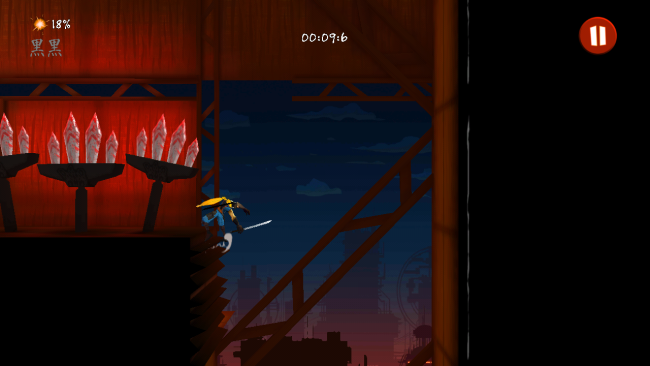
The movement of a ninja needs to be tight, swift, and precise with each delivery. There's no use in sticking to the shadows and sneaking up on your enemies if they're going to be able to disarm you and discard you without a second thought. That's why any ninja-based game on a mobile touchscreen device is a gamble - it's tricky enough as it is to make a platforming game feel right on a touchscreen, so to recreate the feel of stalking your prey as a ninja is really rather difficult.Remarkably, new ninja-based platformer Shadow Blade manages it with grace. While the controls feel a little unorthodox to begin with, they quickly prove ambitious and well considered, with flicks and gestures becoming your window into a world of great set-pieces, wall-jumping, blood-spewing, and rushes to the finish.You play as a ninja student who is attempting to return to his master with important information. Unfortunately there are numerous obstacles and enemies standing between points A and B, and he's going to need to hack and slash his way through the lot of them. Of course, that can only be good news for us - I mean, we need some baddies to make this fun, right?Shadow Blade wants you to feel slick. To this end, the game comes with a control scheme that's a little bit different - you can opt for the regular d-pad style controls, but you'll want to go with the gesture and swiping control set, because it feels really damn good once you properly get into it.
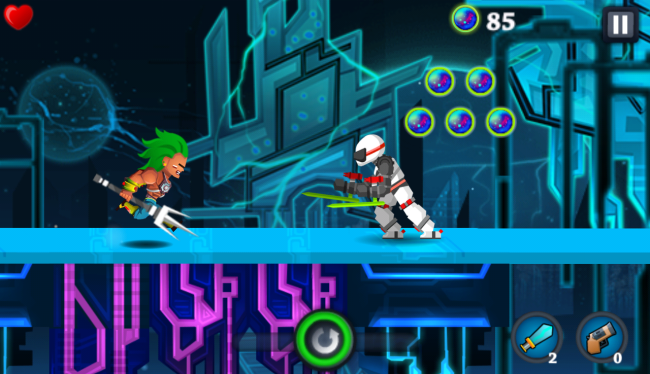
Shiva: The Time Bender, the new endless runner from Tiny Mogul Games, works well as an introduction to the genre, but its lack of difficulty and shallow gameplay could turn off seasoned fans hoping for more substance.In Shiva: TTB, time may be the only thing on your side, as legions of enemies from history's most pitfall ridden locations do their worst in an attempt to thwart a punk rock caveman from capturing a plethora of crystal orbs littering the timescape…or something like that. The narrative isn't very important here, but it does tie in nicely with the game's main mechanic.The gameplay here is pretty standard stuff. Shiva - your player character - jogs, hops, and slays his way through time and space, all the while collecting brightly shining orbs that can be used to upgrade his appearance or weaponry by using the in-game market.The controls should be instantly familiar to anyone who has played an endless runner for a decent length of time: Tapping the left side of your touchscreen causes our green haired protag to hop in the air, and tapping the right side causes him to swing his mighty trident at any manner of foe that stands in his way. And what happens if he misses one of those swings or jumps? That's where the Time Bender mechanic comes into play.
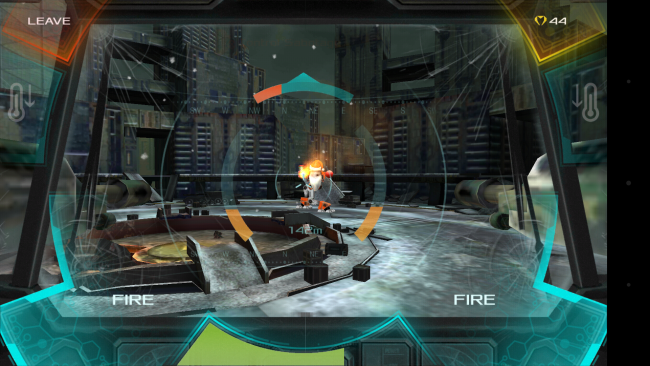
When playing a game for review, I frequently find myself asking "Why?" Why did the developers include or exclude certain features? Why are the controls set up the way they are? Why is my battery almost dead when I'm pretty sure I charged this thing last night? It's important to ask these questions, and receiving answers is necessary in developing a well-rounded view of a game. There are some instances where your ultimate answer will be "I don't know." Once in a while, this answer is fine. In the case of Mechs Warfare, it's the constant answer, and the game suffers because of it.Mechs Warfare (that is not an accidental pluralization) continues the growing trend of large vehicles of destruction battling one another for our entertainment. When I first started playing, I asked myself "Why mechs instead of tanks, spaceships, androids, or monsters?" I don't know why there are mechs. As I played, nothing made me think "Mechs were the best choice." The game is set up with two mechs on opposite sides of a circle. Each one walks on its own, while the players tilt their device to look around and tap each side of the screen to fire the respective side's weapon."It's both fun and challenging to aim with the tilt controls, but every battle is a challenge to see who can land the most shots first. The lack of any real defensive play is baffling. Certain power-ups help that, but not enough to change the game. Why does Mechs Warfare mostly ignore defensive play? I'm not sure. It certainly manages to make the core gameplay simpler without having to worry about movement. Sadly, the trade-off is a game that is quick to get boring. It's tough for me to want to play more than one round in a sitting.Helping to make Mechs Warfare feel more unique is synchronous multiplayer. The game plays well over both my mobile (4G LTE) and Wi-Fi connections, though the latter was much smoother. Synchronous multiplayer is a wonderful decision, but also the only one. There are no single-player or pseudo-multiplayer options as is common in mobile games. Why? I don't know. One of the most unique portions to the game also turns into its biggest flaw once you realize that you are solely dependent on other players to play the game.
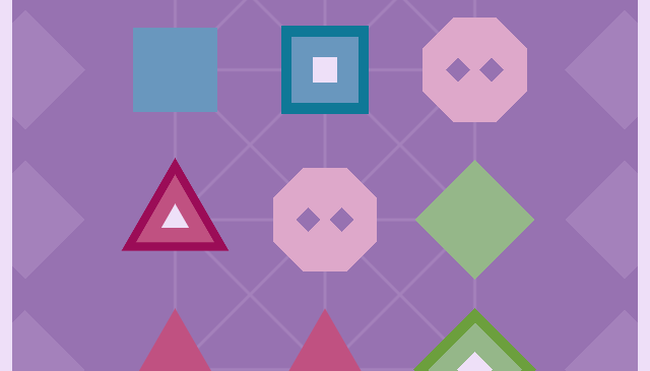
The core gameplay of minimalist puzzler LYNE is reminiscent of classic Arukone: connect two like shapes anchored at different spots on a grid via a single, unbroken line. There are multiple shapes on the board that must be connected—triangle to triangle, square to square—without their distinctly-colored lines crossing each other. But LYNE expands upon this basic rule in a number of ways to enhance the challenge, depth, and ingenuity of an initially simple puzzle foundation. The most obvious of these changes is that LYNE takes place on a graph paper-like grid, allowing lines to be drawn diagonally. In more standard Arukone games, such as Flow Free or Trainyard, each move fills an entire block and can only be dragged horizontally or vertically. LYNE's added dimension doubles the potential moves and strategies available, creating seemingly endless options on even small game boards.To both challenge players further and guide them toward the correct path of the many available, colored spaces that match the end shapes are scattered about the grid. Each of these must be passed through when connecting their related shapes, and can only be touched by their like-colored lines. This means a blue square's line cannot intersect a green diamond's, but you also cannot block off access to the diamond since the green line must reach it. The result is often long, roundabout loops where a line circles the screen before returning to an end shape only one block away, and unexpected solutions to seemingly simple challenges.
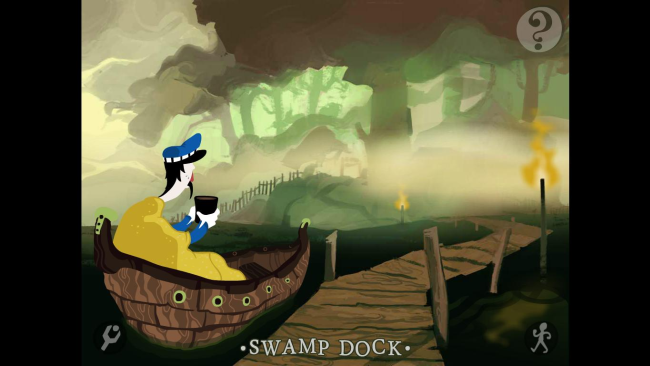
There has been a murder. Richard Remington, the owner of the swampland tourist attraction Boggy's Bog, has been killed in the murky, mushy trenches outside his office. The only suspect to start is Boggy himself, the legendary swamp creature that inspired the creation of the vacation destination and who may or may not actually exist. As the eponymous Detective Grimoire, it's your job to explore Boggy's Bog, investigate the murder, and nab the culprit—human or myth.Players familiar with SFB Games' (formerly Super Flash Bros) 2007 Flash game of the same name will recognize the gameplay in Detective Grimoire. A simplified and streamlined point-and-click adventure, much of your investigation is spent traveling around the swamp, examining beautifully animated scenes, locating clues, and interrogating potential suspects. While both Detective Grimoire and its Flash inspiration revolve around solving a murder in an amusement park, this newest entry into Grimoire's case history presents an entirely new story, cast of characters, and challenges, as well as a different, larger, and more fleshed-out world. All of the dialogue is charmingly voiced, backstories are deeper, and mysteries more elusive. At the same time, Grimoire fans will be treated to playful nods to the original, from jabs at Officer James's facial hair to an uncanny red-headed sidekick.This successful combination of lighthearted jokes and a weighty murder mystery keeps Detective Grimoire consistently engrossing. While Grimoire finds himself in a variety of scenic-yet-creepy locations, from a darkened office lined with shadowy animal heads to a teetering bridge supporting one lone house, the mood of his investigation is upbeat and often humorous. His tone with suspects is more confused than accusatory, and their reactions are unperturbed caricatures.


![All VV Ultimatum Titles [How to Get]](/wp-content/uploads/2026/06/vv-ultimatum-titles.jpg "All VV Ultimatum Titles [How to Get]")