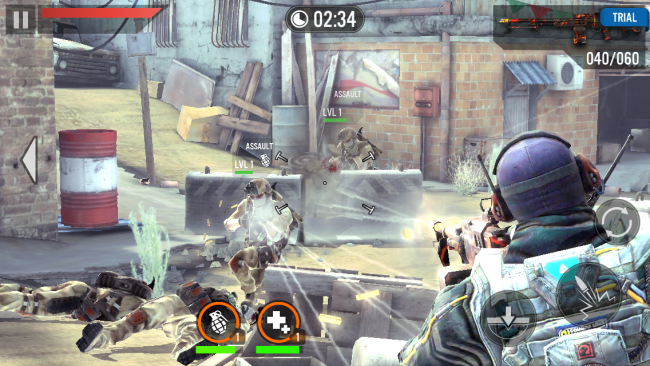
I'm new to the series, so I wasn't entirely sure what to expect when I started up Frontline Commando 2 for the first time. In some ways it's about what I expected: burly dudes that almost could have come from that one really popular game about throwing bullets at one another. But it's also a well-constructed shooter that isn't ridiculously heavy-handed with the in-app purchases. I'd even call it "a lot of fun."There's a story behind the events of Frontline Commando 2, but it's pretty much just a backdrop. Bad guys doing bad guy things has and will always be a great excuse. Each mission takes place in a fairly enclosed area with a few cover points and quite a few enemy soldiers to shoot at. There's no open movement, however - players can tap arrows on either side of the screen to move to a new piece of cover in that direction (best used for avoiding explosives or getting a better angle for a shot), but that's the extent of the movement. Instead, they'll be using the on-screen virtual buttons to focus on aiming, shooting, and reloading. And not getting shot, obviously.
My brother and I were born only about 17 months apart. As such we usually went to the same schools, played with the same friends and watched the same shows.We also look a lot alike. Obviously we're not twins, but those meeting us for the first time often assumed as much. Even today people confuse us, or just refer to us by our collective last name. Our similarities meant we rarely fought, except to distinguish ourselves from one another.We expressed our distinctiveness in the language of GameBoys. Of course we each had to have our own - not just because sharing is definitely not an option, but because they had to be different. They were different colors (mine teal, his purple), we had different carrying cases and, of course, different editions of Pokémon.
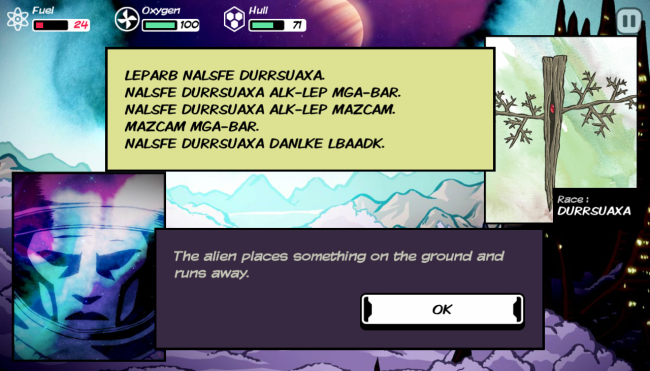
It's three in the morning and I'm trying to get back to Earth as quickly as I can. My oxygen is in short supply, and soon I will suffocate if I don't find a planet with an adequate atmosphere to refill it. Speaking of supplies, I had to scrap half of my gear, including my radar, in order to get the parts necessary to repair my ship's hull after a near fatal encounter with space debris in the last star system. So without the aid of radar, I'm blindly flying to the closest system: the only system my remaining wisps of fuel would allow me to get to. I have no idea what awaits, but I'm hoping for a planet rich in oxygen, with friendly natives, and ample with the resources and fuel that I need to continue my journey.In the deep space of Out There, luck, much like oxygen, is in short supply. I come out of my jump, just short of a black hole; a dead end. I don't have enough fuel for another jump, not that I have enough oxygen to live long enough to even attempt another jump. So, it looks like I won't be making it home."Out There is an unfair and frustrating game. But it's also engaging and fun, at the same time. It is a game where players will curse their luck as often as they will praise it. Players opposed to gambling may be a bit turned away by Out There, as the game relies on luck pretty heavily. But then again, the life of a space explorer would more than likely heavily depend on luck. It's all part of the job.In Out There, players take on the role of an astronaut in the 22nd Century who has just woken up from cryonic sleep to discover that his ship has totally gone off course. Now, with limited resources, the player must leapfrog from star system to star system, in an effort to get back to Earth safely. There are three main resources players must maintain in order to keep the mission going: fuel, oxygen, and hull integrity (iron). Fuel is used to jump to the star systems, travel to planets, and gather resources from the planets. Oxygen is used up gradually over time from doing just about everything, and the ship's hull will take damage from unstable planets as well as a seemingly infinite number of unlucky anomalies that players will undoubtedly encounter during their voyage home. Other resources in the form of elements can be collected and used for ship upgrades.
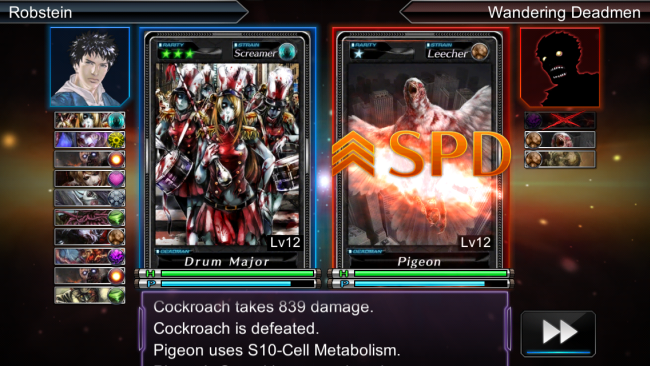
Collectible Card Games can be tough to balance, mechanically. If things are too easy, players will get bored. If it takes too long to accomplish goals or build up a formidable deck, they'll get frustrated. Deadman's Cross seems to be trying to hit that sweet spot somewhere in the middle, but ultimately it misses the mark. And in many ways, it's basically just Guardian Cross with zombies.You assume the role of a run-of-the-mill survivor during the zombie apocalypse - one who follows the government's instructions of staying indoors a little too closely. After three months of isolation (three months!), you finally decide to step outside. Of course the world is a wreck. Zombies, referred to as "Deadmen," are roaming around everywhere and society pretty much doesn't exist anymore. At least not in the same way that it used to. The only way to survive in this world is to pick up a gun and start blasting… and then recruit the defeated Deadmen as your own personal army. I swear I'm not making this up."Your time playing Deadman's Cross will mostly be spent by completing jobs in order to progress and earn special items. Jobs are mostly split between wandering through hallways, hunting Deadmen to add to your collection, and having card duels with anything that moves. There's also an arena where you can indirectly battle against other players' Deadmen in an attempt to earn even more fantastic prizes.Deadman's Cross is, as I've mentioned, incredibly similar to Square Enix's previously released Guardian Cross, but many of those similarities are actually its biggest strengths. Managing your horde is pretty simple and painless. You can feed unneeded Deadmen to more powerful ones in order to level them up, and it doesn't take long before you'll have a sizable force at your disposal.
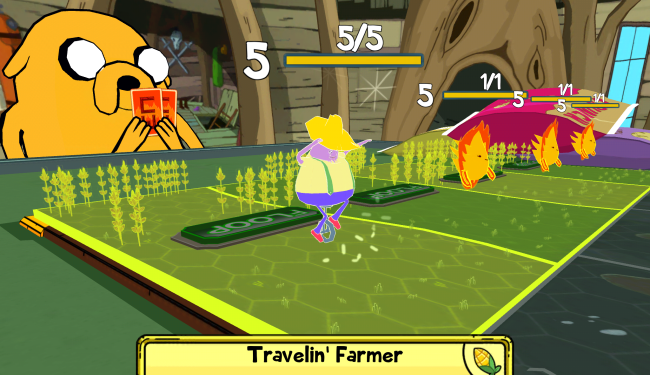
On the list of animated shows I'm glad my daughter likes so I have a plausible reason to watch more of them myself, Adventure Time is right at the top (Littlest Pet Shop, in contrast, is last). So it's with great delight that I report that Card Wars - Adventure Time does right by the show and is better than most mobile card battle games, held back only a bit by its unnecessary two-pronged monetization.Fans of the series probably already know that Card Wars is a real thing in Finn and Jake's universe, kind of their own version of games like Magic: The Gathering. What you play in the mobile game is pretty darn faithful to what we've seen on screen, right down to some of the creatures and buildings, as well as "flooping the pig" — flooping being this game's version of tapping to activate a card's special ability."The biggest difference is that Card Wars - Adventure Time doesn't take that long to figure out, despite Jake's warning that there are lots of rules. Each battle has a setup phase that has each player lay out four landscapes on his or her side of the board. Creatures can only be played into their corresponding landscape, except for rainbow cards that can be played anywhere.Only one creature can be played at a time into each of the four lanes. All of them have varying mana costs to play, plus values for attack and defense. The other types of cards are buildings, which buff the creatures in their lanes, and spells, which have a variety of effects. The Volcano, for instance, wipes out everything in its lane on both sides of the board.
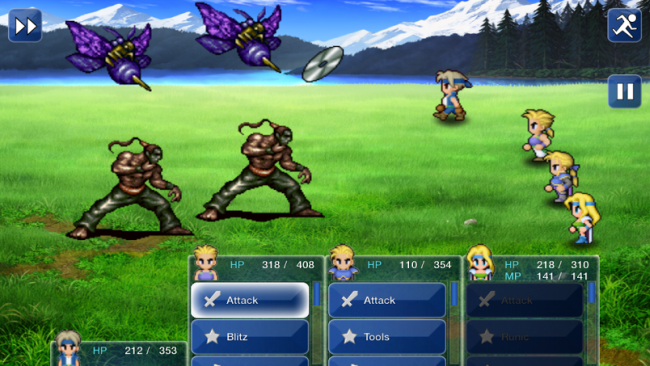
Another day, another controversial remake of a classic RPG from Square Enix. This time, the beloved SNES epic Final Fantasy VI is getting the "Vaseline treatment" - that is to say, this mobile rerelease has had its scenery and characters smoothed out to hide its pixel-based shame.The end result looks awful, but what's really important is how Final Fantasy VI plays on mobile. And, well, after all these years, the game still ranks amongst the best RPGs released during the 90s and early aughts, a golden era for the genre."Final Fantasy VI has a pretty ambitious story that's still compelling to follow. One thousand years after the destructive "War of the Magi," magic vanished from the planet and was replaced by steampunk and other technology. Magic and the people that used it faded into legend - but a slow trickle of magic is coming from an unidentifiable source, and it's enough to send the land's Emperor on a hunt for this ancient power.War quickly follows, and the conflict grows until the apocalypse cracks the earth, poisons the water, and mutates the animals. No, really.
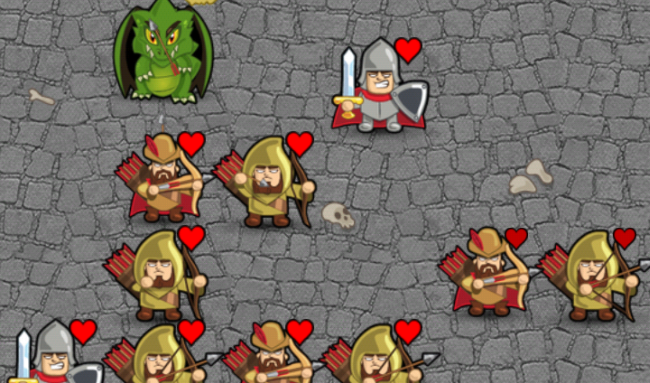
If two game genres ever deserved to be nominated for a "most over-used" designation, it's match-three and tower defense. Still, the shelf life of stale mechanics can often be extended a bit by creating unexpected combinations as new match-three/tower defense game Puzzle Defense: Dragons has managed to do. While this cute little game isn't exactly a paragon of innovation, it does offer a generous amount of free-to-play fun.Puzzle Defense: Dragons has two modes: Campaign and Battle. The significant difference between the two is that the first has combat happen in stages as you progress across a map, and the second has it go on indefinitely (or until you run out of reinforcements). Also, Campaign mode has a weensy bit of implied narrative (re: the dragon attack on your resident kingdom) and gives you five lives/chances to fulfill each level's objectives. Battle mode on the other hand, is continuous and does away with the story add-ons."Whichever the mode, the match-three element of Puzzle Defense: Dragons is clever, since rather than having you rearrange existing icons within a grid, it asks you to create matches by placing the icons yourself. In this case, the icons represent different types of military units starting with a basic swordsman (who's more or less useless) and continuing through more powerful units such as archers, snipers, king's archers, and heavy crossbowmen.The idea is to group three or more of the same unit next to one another. This combines the three and transforms them into a single, more powerful unit. The progression of this works in the order listed above—three swordsmen equal one archer, three archers equal one sniper, and so on. The strategic part comes in as you determine where to create these groupings, especially since once placed, units are immovable (in general).
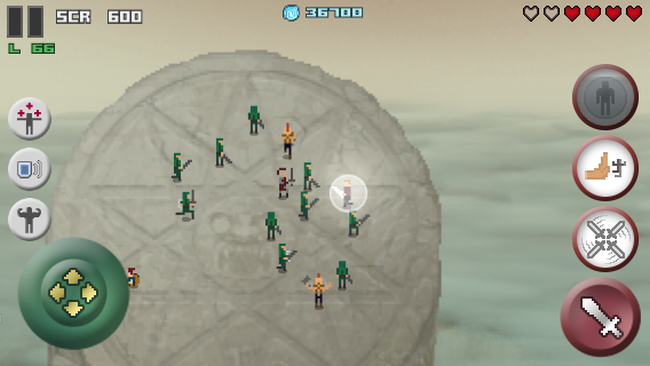
Before I even knew what was happening, I had a magical sword in my possession and the bad guys were teleporting in to try and kill me. Naturally, I reacted as any magic sword-wielding hero would when facing down a horde of enemies: I paid $1.99 and froze them all with my newly purchased frost spell —but only after I had to put the fight on hold in order to decline rating my experience thus far.Only One is a fun game that is hampered by constant, tacky reminders that you can spend your money in the game to power-up your hero. While it would be silly of me to say that a developer has no right pointing the player in the direction of where the in-app purchases reside, I feel like it's counterproductive to stop the game every time a new pair of items in the store are available to purchase. Point the player in the store's direction the first time it becomes available; anything beyond that and it feels like a nagging merchant following you through the flea market, trying to get you to buy his stuff.Ignoring the bouncing arrows and pop-ups reminding the player to rate their experience, Only One is a relatively fun game. Developed by Ernest Szoka, Only One is a top-down sword fighting game where players battle atop a mystical battleground, high up in the clouds. Enemies teleport in as others are dispatched and they can all be killed with sword attacks or magical abilities that the player unlocks by spending the points they collect from slaying other enemies. Kill an enemy and they drop loot; knock an enemy off the side of the battleground and more points are awarded, but the majority of the loot will follow the doomed opponent off the edge.


![All VV Ultimatum Titles [How to Get]](/wp-content/uploads/2026/06/vv-ultimatum-titles.jpg "All VV Ultimatum Titles [How to Get]")