


Best Horror Games On Itch.io – July 2026
Across a bounty of subgenres.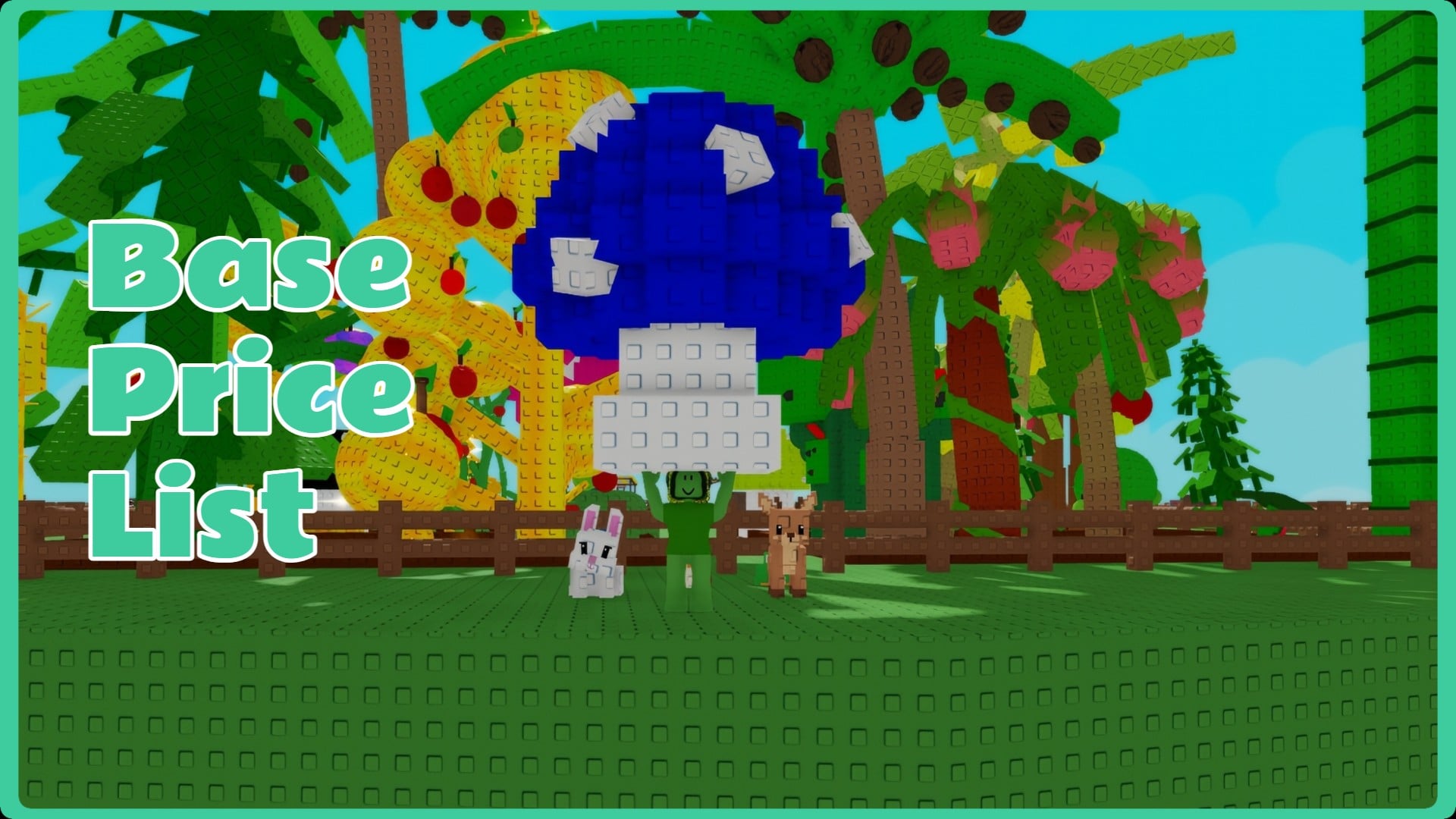
Grow A Garden 2 Base Price List
What's the most valuable crop?![Evomon Best Starter [Leafbun, Blazpup, or Bubble?]](/wp-content/uploads/2026/06/evomon-best-starter.jpg "Evomon Best Starter [Leafbun, Blazpup, or Bubble?]")
Evomon Best Starter [Leafbun, Blazpup, or Bubble?]
Grass-type, Fire-type, or Water-type?
![[Roblox] Evomon Shiny Hunting Guide – Including Prismatic and Pris Shinies!](/wp-content/uploads/2026/06/evomon-shiny-hunting-guide.jpg "[Roblox] Evomon Shiny Hunting Guide – Including Prismatic and Pris Shinies!")


PC Reviews
King Arthur’s Gold Review
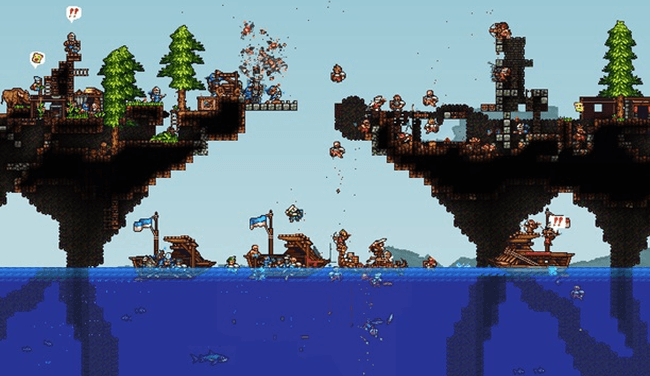
King Arthur's Gold is one of those strange indie titles that appears to be constantly in beta - i.e. not completely ready according to the developers, yet still available to purchase in its current state. The game was also in beta back when I played it more than two years ago as well, so it's anyone's guess when the "full release" will happen.Still, there's a lovely online multiplayer experience to be found in amongst all that treasure, especially if you can get a bunch of friends involved. It may be perhaps a little too "hardcore" for some players, but if you've enjoyed 2D sandbox-style games like Terraria and Junk Jack X, then King Arthur's Gold may well be up your street.You take control of a war-wager, part of a larger team that is looking to take out the opposing team by any means necessary and steal their flags. Everything provided is in a very medieval vein, from the classes you can select, to the machinery you can take control over. By working together with the rest of your team, it's possible to build up your castle's defenses, and then rain hell down on the opposition.The action takes place on a 2D Terraria-like plane, with each individual block in the world available for smashing up or building on top of. The Builder class is able to chop down trees and build grand-scale structures to keep the enemies out, while the Archers and Knights are tasked with keeping baddies at bay. It's all about balancing who takes what classes in your team of up to 16 bloodthirsty wretches.
Master Reboot Review
In the not-too-distant future of Master Reboot, death is no longer an end, merely a transition. Thanks to the Soul Cloud, a spiritual software storehouse, owners of Soul Cloud real estate can upload their very being to the database and then spend the rest of eternity re-experiencing memories from the time they were alive. Still-breathing friends and family can visit these memories as well, even sending messages to the deceased-but-not-gone inhabitant of the Cloud via luminous blue rubber ducks.Your experience in the Soul Cloud begins amidst disaster; you awaken unaware of who you are or why you're there, stumbling toward your personal memorial hub as bits of corrupt data flash within the scenery. A mangled voice taunt-whispers from nowhere, "Remember..." while a glowing glyph threatens you with a Hieronymus Bosch-style demonic calling card. What should be an idyllic induction to your eternal rest home has become a haunted, confusing space devoid of answers to the endless questions circling your mind.Master Reboot places you in the shoes and emotions of this unknown soul directly; there's no tutorial, introduction, or hint of what is going on to either player or protagonist. Until you pass through the empty Soul Cloud induction office, you may not even realize where you are. Because of this, from minute one, you're incentivized toward all aspects of this psychological horror puzzle adventure: perturbed by the not-quite-rightness of your surroundings, encouraged to figure out who and why you are, and motivated to explore further to do so.
Combat Monsters Review
Combat Monsters, the virtual card battle game with echoes of Magic: The Gathering is now in full release, and if you played and enjoyed it during the beta period, you'll be pleased to know that very little has changed over the past couple of months. And if you haven't, you probably should - it's a fun, challenging strategy card game, and while some of the multiplayer features are lacking, it gets the free-to-play formula right, a rare accomplishment these days.Even if you have only a basic idea of what Magic: The Gathering is, there's no mistaking the similarities between that famous card game and Combat Monsters. In fact, Paul Johnson, the co-founder of Rubicon Development is an "avid player" of Magic, but wanted a video game with a more tactical experience. Thus, Combat Monsters, in which you not only collect virtual cards of various types and abilities and deploy them in single and multiplayer duels, but also maneuver on a 3D game board, complete with special hexes that can amplify your powers - or your enemy's."Combat Monsters is very much an "easy to learn, tough to master" game. You begin by choosing a hero - a warrior, an archer, or a mage - who will serve as your personal avatar, and are then given a basic starting deck with which to play. The bulk of your deck will, initially at least, be composed of various fantasy monsters like orcs, minotaurs, elves, zombies and so forth, each of which belongs to one of the three character classes; there are also cards for weapons, armor, equipment, spells, and magical runes. Some "supplemental" cards only work with specific races or classes, and some monster cards have special abilities that manifest under the right conditions: zombies gain health whenever a monster on the board dies, for instance, while orcs gain an attack bonus for every friendly orc in play.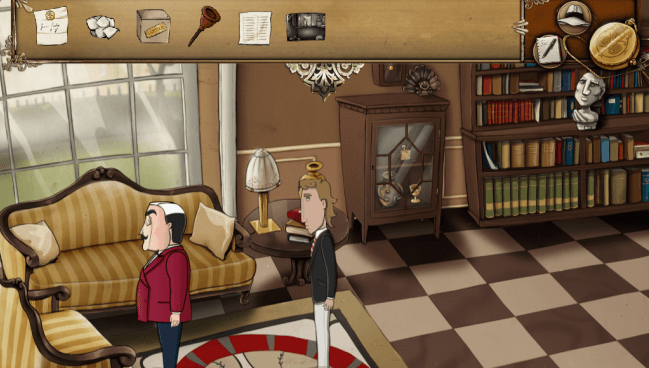
Dream Chamber Review
Dream Chamber is a brand new point-and-click adventure game from Microids that's set in 1930s America, and gives players a highly stylized tale of item collecting and dialogue trees. The storyline itself is par for the course with engaging detective novel fare, and features a cartoony, almost-noir sense of presentation and progression. You play as Charlie Chamber, a wealthy-beyond-words man who's taken it upon himself to try his hand at being a private detective, much to the resistance of the actual private detectives in town. But when a highly publicized museum theft occurs at his girlfriend's latest charity event, Charlie will stop at nothing to make sure that he's the one on the case!It's a very nice setup, and the action moves along accordingly at a pretty fair pace, although most of the characters that populate the game world of Dream Chamber are decidedly unlikable, especially Charlie's vapid girlfriend and the creepy dream version of Charlie named Charles. However, the visuals and sound design more than make up for what Charlie and company might be lacking in the personality department. Everything in the game positively pops with bright and colorful illustrations, and a cool wavy visual effect really accentuates the many dream sequences, in addition to some serious top-notch voice-over talent. The actual gameplay is standard point-and-click adventure in every sense of the word; but the big twist here is that Charlie has the uncanny ability to revisit everywhere he's been in his own dreams, to get a deeper or longer look at some all-important evidence!"For instance, in one scene early on in the game, the inspector working the case accidentally drops a list of stolen items onto the floor of his office. Charlie, being the well-mannered gentleman that he is, quickly bends down to pick up the list and promptly gives it back to the impatient inspector, silently wishing he had more time to look over the items on the list in greater detail. When players return to the dream version of this scene a few short moments later, a glowing stolen objects list rests on the floor exactly where the inspector had dropped it in real life, allowing Charlie to scrutinize its contents now in the privacy of his own subconscious mind. It's certainly an interesting mechanic, and one that serves to accentuate all of the amateur private investigating that you'll be doing by day (NOTE: Just be sure to go into the menu and manually save your game at regular intervals, as Dream Chamber disappointingly does not seem to include any sort of auto-save feature).
Leap Motion Review
Have you ever wanted to be Tom Cruise? Of course you have. Whether it's Top Gun Tom Cruise, Risky Business Tom Cruise, or even the Tom Cruise that jumps on Oprah's couch and scares the hell out of everyone in real life, there's been at least one moment in your life that you've wished you could be Tom Cruise. And now - so long as you'll settle for Minority Report Tom Cruise - your dream can come true for $79.99.That's the price of the Leap Motion - or as everyone I've talked to in the last year calls it, "that device that turns your computer into the gesture-controlled thingy from Minority Report." It's a comparison that the company is no doubt growing tired of, but that won't stop me from hammering that point home over the first two paragraphs of my review.That's because it's a comparison that's so well-warranted. The Leap Motion promises to let users control games (and other apps) by waving their hands and fingers in the air, pointing and prodding to guide elements on the screen to achieve their desired result. Ready for the shocker? IT ACTUALLY WORKS.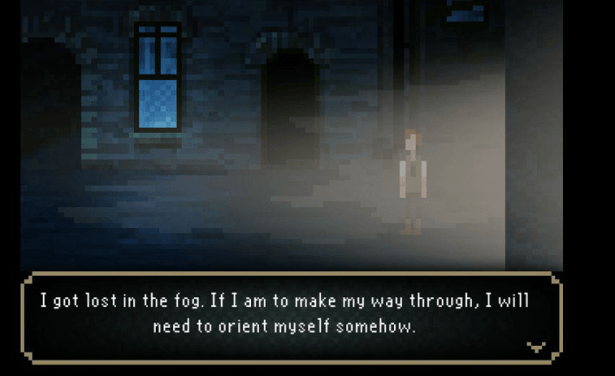
The Last Door: Chapter 3 – The Four Witnesses Review
The Last Door: Chapter 3 - The Four Witnesses is the first time that our protagonist, Jeremiah Devitt, is completely without control. In chapters one and two, he deliberately traveled to Beechworth Mansion and his old boarding school, respectively, in an attempt to uncover what drove his friend Anthony to madness and the source of his own nightmares. While Devitt ultimately unearthed more questions than answers, this search was driven by a personal desire for knowledge and clarity. In The Four Witnesses, someone else is pulling the strings.Devitt begins this installment in the same predicament that ended Chapter 2 - Memories: trapped in darkness. Forcing his way to freedom, a dehydrated and weakened Devitt soon learns he's been transported to the slum of Old Nichol in London, a fair trek from the boarding school in Scotland where he lost consciousness. With no sign of his captors and only a mysterious ticket to the play "The Four Witnesses" in his pocket, Devitt must try to find his way out of Old Nichol and back home. Surrounding the slum, though, is a dense fog that can only be navigated with the proper "map." Finding said map, and the strange red-headed man that seems to be leading Devitt around the city, are our two main goals in The Four Witnesses."Despite having these concrete goals to work toward, The Four Witnesses is more vague and mysterious than its preceding chapters. The inclusion of interactive, non-playable characters has returned from chapter 2, providing Devitt a variety of dialogues to initiate and pursue. Many of these characters speak in partial riddles, whether it's the fortune teller who recommends you follow "the path of the bird" or the decrepit composer who directs you to "search the Simurg." These, and other seemingly random comments, are critical to finding your way through the fog, but they come off as nonsensical-yet-poetic ramblings until you have collected all the pieces of the puzzle.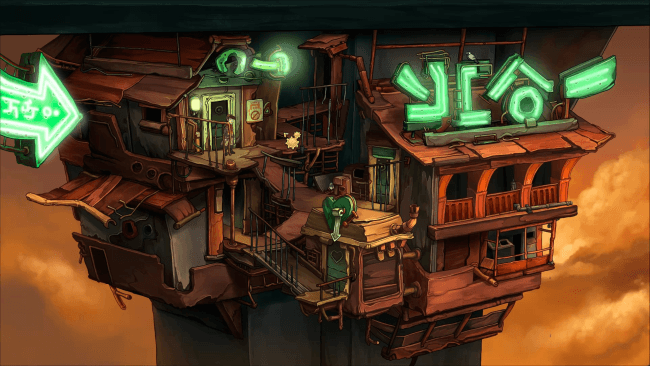
Goodbye Deponia Review
Goodbyes are often some of the hardest things to do in life: especially when it's time to say goodbye to one of the most applauded series of adventure games that we've played in quite some time. Goodbye Deponia picks up right where Chaos on Deponia left off, with our ragtag band of heroes Rufus, Goal, Doc and Bozo on their way to the floating utopia of Elysium to stop Organon and company from destroying Deponia once and for all. The story is full of some nice twists and turns (most of which are on account of something Rufus has said or done), and the sharp and humorous wit of Daedalic's many flawed characters makes for one hell of a conclusion to this fine trilogy of modern point-and-click adventure games.It will probably come as no surprise to those of you who are already familiar with Daedalic's impressive roster of point-and-click adventure games, but Goodbye Deponia positively shines in its presentation. The stylized cartoony visuals are constantly bursting with color and personality, and the different locations you'll adventure to around Deponia and Elysium are a breath of fresh air to the genre. The sound quality is also extremely top-notch as always, with witty musical numbers and some of the best vocal performances I've ever heard in a point-and-click adventure game. The animations are syrupy slick and smooth, and the only real hiccup I found on the technical side of things was in the abruptness of some of the cutscenes, where the screen would quickly cut to black at regular intervals, resulting in some pretty choppy transitions to the overall storytelling."Serving as the perfect complement to the game's visual presentation is the actual writing, which packs in so much of the situational humor and squabbling banter and asides that fans would only expect from Rufus and his crew. In fact, much like the first two games in the Deponia series, the question of whether or not you'll find the game's humor appealing will largely depend on how much you like the half-witted backwards hero Rufus himself. Rufus can definitely be an acquired taste for some, and his sheer stupidity at times and roundabout ways of thinking can be a little much to take at first. But if you've made it this far into the trilogy, then the odds are that you find our hero's helter-skelter methods oddly endearing, and truth be told, Daedalic really allows Rufus to shine here for the majority of Goodbye Deponia.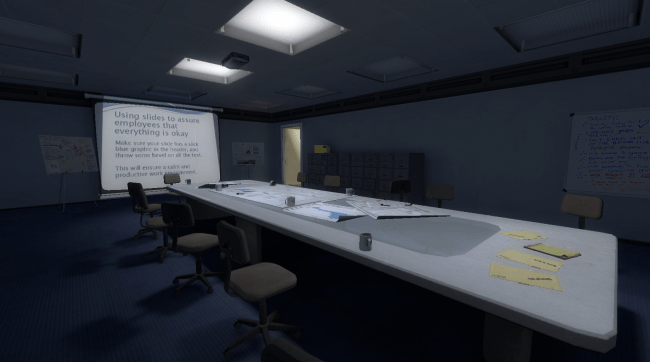
The Stanley Parable Review
This is the story of a man named Stanley. Stanley worked for a company in a big building where he was employee number 427. Employee number 427's job was simple - he sat at his desk in room 427, and he pushed buttons on a keyboard. Orders came to him through a monitor on his desk, telling him what buttons to push, how long to push them, and in what order. This is what employee number 427 did every day of every month of every year, and although others might have considered it soul-ripping, Stanley relished every moment that the orders came in, as though he had been made exactly for this job. And Stanley was happy.And then one day, something very peculiar happened. Something that would forever change Stanley. Something that he would never quite forget. He had been at his desk for nearly an hour, when he realized that not one single order had arrived on the monitor for him to follow. No one had showed up to give him instructions, call a meeting, or even say "hi." Never in all his years at the company had this happened - this complete isolation. Something was very clearly wrong. Shocked, frozen solid, Stanley found himself unable to move for the longest time. But as he came to his wits and regained his senses, he got up from his desk and stepped out of his office."All of his co-workers were gone. What could it mean? Stanley decided to go to the meeting room - perhaps he had simply missed a memo. When Stanley came to a set of two open doors, he entered the door on his left, the utterly perfect narration for his outlandish, sprawling tale working in unison with the first-person perspective to create one of the most charming, story-driven video games ever created.